If you’ve ever found yourself Googling “Bail in Bangladesh” at 2 AM trying to make sense of legal terms that feel straight out of a courtroom drama — don’t worry, you’re not alone. Bail might sound complicated, but once you break it down, it’s actually a pretty logical system built around fairness, rights, and accountability.
In this blog, I’ll walk you through how bail works, why it matters, and the practical steps involved. We’ll also look at the different types of bail, what courts consider before granting it, and how people can navigate tricky situations like bail rejection or cancellation.
What is Bail?
At its core, bail is a legal mechanism that allows an accused person to remain out of jail during the investigation or trial—on the condition that they show up in court when required. Basically, it’s the justice system saying, “Alright, we trust you… but don’t make us regret it.”
This concept is rooted in the golden principle of criminal law: “innocent until proven guilty.” The core idea is that pre-trial detention should be the exception, not the rule.
Courts use bail to balance two things:
- The accused person’s right to liberty: a fundamental right under our Constitution.
- The public’s interest in justice: ensuring accused individuals don’t disappear or interfere with investigations.
This is where things like a bail bond in Bangladesh make sense — it’s simply a guarantee (often monetary) that the accused will return when needed.
Types of Bail
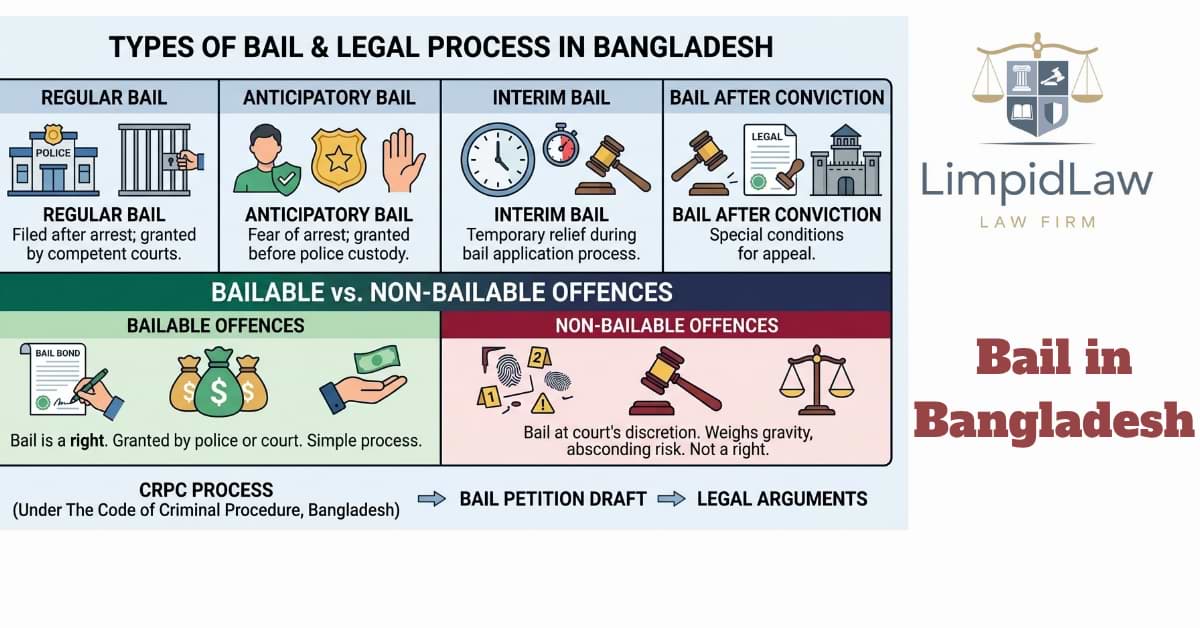
Think of bail types like different flavors—same concept, different situations. Here are the most commonly used types of bail:
1. Regular Bail
This is what most accused people apply for after being arrested. This is the more common scenario. You apply for this after you have already been arrested and are in police or judicial custody. This can be granted by the court that has the authority to try the case (like a Sessions Judge or a Magistrate).
2. Anticipatory Bail
This is the legal safety net you apply for before arrest when you fear police might pick you up. Courts grant it when they are convinced an arrest isn’t necessary.
This is why many people look up anticipatory bail in Bangladesh or even ask how to get anticipatory bail in Bangladesh before approaching a lawyer.
3. Interim Bail
A temporary relief given while the court decides on the main bail prayer.
4. Bail After Conviction
Rare but possible under special circumstances.
The Legal Backbone: Bail Under CrPC in Bangladesh
The Code of Criminal Procedure (CrPC) sets the ground rules for how bail works. From the court’s power to grant bail to the way police handle bailable vs. non-bailable offences, the CrPC drives the process.
Many people, especially young lawyers, often search for templates like bail petition draft in Bangladesh to understand how to structure bail prayers under the CrPC.
And honestly, it’s smart — a well-structured application can make a big difference in how the court perceives your case.
Bailable vs. Non-Bailable: What’s the Actual Difference?
Let’s clear up a popular confusion. People often think:
- Bailable = Court must grant bail.
- Non-bailable = No bail possible.
Not quite. Here’s what it really means:
Bailable offences
These are less serious crimes. If you’re accused of a bailable offence, getting bail is a matter of right. The police or the court must grant it. You just need to sign a bail bond in Bangladesh, which is a legal document where you promise to appear in court. The court may also require a surety (someone who vouches for you) or a financial deposit.
Non-bailable offences
These are serious crimes like murder, rape, or armed robbery. Here, bail is not a right but a privilege granted at the discretion of the court. The court weighs multiple factors like:
- Nature of offence
- Chances of absconding
- Criminal history
- Investigation stage
This is why many advocates maintain a List of bailable and NON bailable offence in Bangladesh as a quick reference.
The Bail System in Bangladesh: How It Actually Plays Out
On paper, the bail system in Bangladesh aims to ensure fairness and prevent unnecessary detention.
Here’s the usual flow:
- A bail application is filed (often following a standard bail application format in Bangladesh).
- The court reviews the allegations and case records.
- The judge considers the gravity and the accused’s background.
- Arguments from both sides are heard.
- Bail granted or rejected.
If granted, the accused signs a bail bond in Bangladesh.
If rejected? They can apply in a higher court.
The Paper Trail: Drafting Your Defense
The key to unlocking the courtroom door is a well-prepared application. A bail petition draft in Bangladesh is a formal written request submitted to the court. It’s not just a formality; it’s your first and most important argument.
A strong bail application format in Bangladesh will typically include:
- Facts of the case from your perspective.
- Reasons why you deserve bail (e.g., false implication, weak evidence, you are a student with roots in the community, etc.).
- Legal arguments citing relevant sections of the CrPC and past court judgments.
- An offer to comply with any conditions the court sets.
Getting this document right is a specialized skill, which is why you should never navigate this process alone.
When Bail Gets Cancelled
Yes, bail isn’t permanent. Courts can order cancellation of bail in Bangladesh if the accused:
- Violates bail conditions
- Threatens witnesses
- Conceals information
- Commits a new offence
- Attempts to escape
The justice system ultimately prioritizes fair trial and public safety.
Key Comparisons and Practical Insights
Let’s look at some helpful comparisons to get a clearer picture:
Anticipatory Bail vs Regular Bail
| Feature | Anticipatory Bail | Regular Bail |
| Timing | Before Arrest | After Arrest |
| Purpose | Prevent unnecessary arrest | Secure release from custody |
| Difficulty | Harder, more scrutiny | Depends on offence |
Bailable vs Non-Bailable
| Aspect | Bailable | Non-Bailable |
| Right to Bail | Yes | No automatic right |
| Police Role | Can grant | Cannot grant |
| Court scrutiny | Minimal | High |
So, What Should You Keep in Mind?
Here are some simple but powerful takeaways:
- Bail is a right, but not unconditional.
- Good legal representation matters.
- Well-prepared petitions carry immense weight.
- Anticipatory bail is a useful protective measure—but must be justified.
- Violating bail terms is a straight ticket back to custody.
- Documentation, accuracy, and conduct play a big role.
Frequently Asked Questions (FAQs)
Q. What is the basic process of getting bail in Bangladesh?
A. You submit a bail application in court, your lawyer presents arguments, the judge reviews the case details, and if convinced, grants bail subject to bail bond conditions.
Q. What is the main difference between anticipatory bail and regular bail?
A. Anticipatory Bail: Applied for before an arrest happens. It’s a pre-emptive measure to prevent custody.
Regular (Post-Arrest) Bail: Applied for after you have already been arrested and are in jail. It’s a remedy to get out of custody.
Q. Can I get anticipatory bail in Bangladesh?
A. Yes, but only from higher courts (Sessions Court or High Court), and only when you demonstrate genuine fear of arrest and no misuse of the process.
Q. What documents are needed for a bail application?
A.
- Copy of FIR
- Case number
- Statement of allegations
- Vakalatnama
- Personal details of the accused etc.
Q. What leads to cancellation of bail?
A. Violating bail conditions, tampering with evidence, threatening witnesses, new criminal activity, or absconding.
Q: What happens if my bail is cancelled?
A. If the court orders the cancellation of bail in Bangladesh, a warrant for your arrest will be issued. You will be taken back into custody and will have to remain there for the remainder of the trial, unless you can successfully apply for a fresh bail order.
Q. Are there offences where bail is not allowed at all?
A. Yes—particularly serious crimes like rape, murder, terrorism, offences under special laws, and some narcotics cases. These are strictly non-bailable and heavily scrutinized.
Q. What is a bail bond?
A. Formal written guarantee where the accused promises to appear in court. It may involve financial sureties.
Q. Is a bail bond the same as paying a fine?
A. No, absolutely not. A bail bond is a financial guarantee or a promise to the court that you will appear for your trial. It’s more like a security deposit you get back if you comply with all court orders. A fine, on the other hand, is a monetary penalty imposed as punishment after you are found guilty.
Q. Is having a bail petition draft in Bangladesh helpful?
A. Absolutely. A structured draft ensures the legal grounds, facts, and appeals are presented clearly.
Q. How long does it take to get bail?
A. There’s no fixed timeline. For a bailable offence, it can be processed within hours. For a contested non-bailable offence, the hearing process can take days, weeks, or even longer, depending on the complexity of the case and the court’s schedule.
Q. Can the police refuse bail in a bailable offence?
A. Technically, no. In bailable offences, bail is a legal right.
Q. What are the common types of bail?
A. Regular bail, anticipatory bail, interim bail, and post-conviction bail.
Q. Can I write my own bail application?
A. While it’s legally possible, it is highly inadvisable. The bail petition draft in Bangladesh requires precise legal knowledge, understanding of case law, and strategic argumentation. A small mistake can lead to your application being rejected. Always, always hire a competent lawyer.
Conclusion
Bail doesn’t have to feel like a maze. Once you understand how the laws work, the terminology, and the rights you’re entitled to, the whole system becomes far less intimidating.
The bottom line?
The bail framework is designed to protect liberty while keeping the justice process running smoothly. Whether you’re dealing with regular bail, anticipatory bail, or just trying to make sense of CrPC , having the right legal guidance makes all the difference. Stay informed, stay calm, and always approach the process step by step.
The content of this blog is for knowledge or information sharing purpose only and may not be relied on as legal advice. In terms of getting any legal help we always strongly advise to contact a professional lawyer. For professional legal help you can call or contact here.
Written By:
Sheikh Saiful Islam Rajib
Advocate, Supreme Court of Bangladesh