If you’re wondering how to legally transfer property in Bangladesh, you’ve come to the right place. Whether you’re buying a plot of land, transferring ownership to a relative, or investing in real estate from abroad, understanding the process is key. In this blog post, we’ll walk through the steps, laws and practical tips in an easy-to-read, conversational way—so you feel confident, not confused.
Why Registration matters (and what you might overlook)
The legal transfer of property is more than signing some papers and handing over money. If things aren’t done right, you could end up with disputes, loss of rights or even invalid deeds. In Bangladesh, the process is governed by a structured framework—so you’ll want to be clear about:
- The correct legal document for transfer of property being used.
- Registration and official formalities being fulfilled.
- Your rights, protections and potential liabilities under the system.
Missing any of these steps could mean you might hear later: “The deed is not registered, so it’s not legally enforceable.” For example, any transfer without registration can leave you in a tough spot.
Key laws you should know
When dealing with property in Bangladesh, some of the pivotal pieces of legislation are:
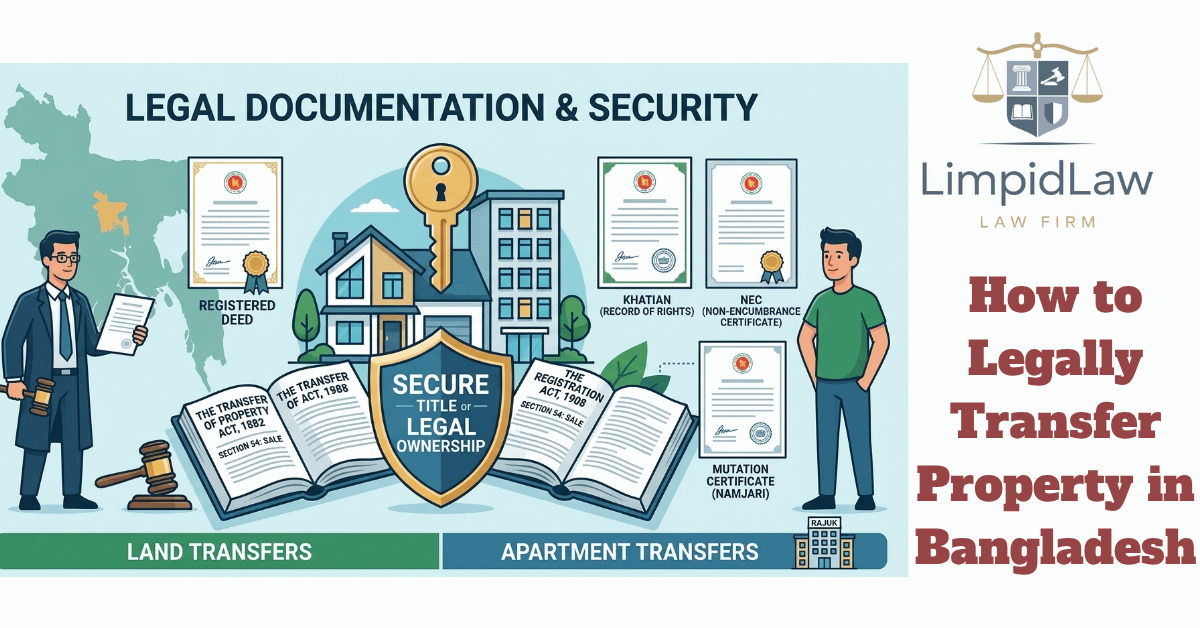
- The Transfer of Property Act, 1882 (often just called the “TP Act”) which regulates how property is transferred by act of parties.
- The Registration Act, 1908, which mandates when documents must be registered to make them legally valid.
These laws tell you things like: what “transfer” means, what property types are covered (movable vs immovable), and the formalities required. For example, under the TP Act, “immovable property” does not include standing timber or growing crops.
The Essential Steps for Legal Transfer of Property
Let me break down the actual process you’ll need to follow. I’ll keep it straightforward because nobody wants to get lost in legal jargon.
Step 1: Verify Ownership Documents
Before anything else: verify that the seller (or transferor) is actually the owner, and that the property is free of encumbrances. This is linked to the concept of “title” and “real rights” under the TP Act.
Start by checking the Record of Rights (also called Khatian) at the Ministry of Land’s Land Office. The name of the transferor must be found in the latest Khatian, and if the name is not mutated, the Sub Registrar will refuse to register the deed. This is non-negotiable—no proper documentation means no registration.
You’ll want to verify at least 25 years of ownership history to ensure there are no hidden claims or disputes lurking in the background.
Step 2: Obtain a Non-Encumbrance Certificate (NEC)
Visit the sub-registry office to collect this crucial document. The NEC confirms that the property is free from legal disputes, unpaid loans, or mortgages. Skipping this step could mean inheriting someone else’s financial troubles along with the property.
Step 3: Decide on the mode of transfer
Under the TP Act, there are different modes: sale, gift, lease, exchange, etc.
For example:
- Sale: transfer for consideration (money) – defined in Section 54 of the TP Act.
- Gift (Heba): transfer without consideration but with required formalities etc.
Step 4: Prepare the Transfer Deed
You’ll need a legal document that records the agreement between parties. This is the “legal document for transfer of property”. According to Bangladesh land laws, the government has set a predefined format for property transfers. Your deed must follow this exact format. It should clearly specify the property details, parties involved, consideration amount (if any), and terms of transfer.
Step 5: Execute & register the deed at the Sub-Registry Office
One of the most critical steps: registration. Without registration the transfer may be void. For example, under the Registration Act, certain instruments require registration; and the TP Act mentions that property rights obtained via unregistered documents may not be enforced.
Also, registration must occur at the Sub-Registrar’s office in the relevant upazila/district where the property is located. The registration requires registration fees and taxes
These payments must be made before registration—no shortcuts here. Keep all receipts because you’ll need them for the next steps.
With all documents and payment receipts in hand, visit the local Sub-Registrar’s Office. Both parties (buyer and seller) must be present with their identification documents. The sub-registrar will verify everything, and if all is in order, your transfer deed will be officially registered.
This registration makes the transfer legally recognized and creates an official record that you can reference for years to come.
Step 6: Complete the Mutation Process
Registration alone doesn’t update government land records. You need mutation (locally called “Namjari”) for that. Mutation is the official process of registering a new owner’s details with the relevant government authorities following a property transfer.
Submit your mutation application to the Assistant Commissioner of Land in your area within one month of deed registration. The process involves inspection and verification before your name appears in the official Khatian. This ensures that ownership is properly recorded and recognized by local authorities.
Step 7: Archiving, monitoring and possession
Keep all the documents safe: registered deed, payment receipts, mutation certificate, etc. Also monitor that no surprise charges or claims appear later (for example, if someone challenges the title). Keep the possession of the property intact.
Understanding How to Transfer Land vs. Apartments
The property transfer act Bangladesh applies to both land and apartments, but there are some practical differences worth noting.
For land transfers, you’re dealing directly with the Sub-Registry Office and Land Office. The process is relatively straightforward once you have all documents in order.
For apartments, especially those in development authority areas like RAJUK (Rajdhani Unnayan Kartripakkha) in Dhaka, there’s an additional layer. You need RAJUK Sale Permission—a written consent from RAJUK allowing the legal transfer of flats, plots, or commercial spaces. This typically takes 3-4 months to obtain and is required before you can register the deed.
Common Mistakes to Avoid
Through my research and conversations with legal experts, I’ve identified several pitfalls that trip up buyers and sellers:
- Incomplete documentation: Missing even one document can delay your registration by weeks or months. Create a checklist and verify everything twice.
- Ignoring mutation: Ignoring the need to mutate the name in registry records after registration..
- Overlooking title verification: Always verify the full ownership chain. Fraudulent transactions remain a concern, and thorough verification protects you from inheriting legal battles.
- Skipping professional help: Property law in Bangladesh involves intricate details. Consider hiring a property lawyer, especially for high-value transactions or complex inheritance cases.
- Assuming a verbal gift or sale is sufficient—written & registered instrument is needed especially for immovable property.
Special Considerations for Different Transfer Types
Gift Transfers (Heba)
When gifting property to family members, you still need proper documentation. A registered Heba deed, proof of possession, and identity documents of both parties are required. The good news? Gift deeds have lower stamp duty rates, typically around 0.5% of the market value.
Inheritance Transfers
If you’re inheriting property, Bangladesh’s inheritance laws depend on your religion. Muslim, Hindu, Christian, and Buddhist inheritance rules differ significantly. Regardless of religion, you’ll need succession certificates or heir certificates before initiating the transfer process.
Exchange Transfers / Exchange Deed
In property exchanges (where two parties swap properties), both properties require a single transfer documentation and registration. Such deed usually called Exchange Deed (also known as an ewaz or binimoy dolil in Bengali). It’s essentially single property transfer and the fees will also be same as a single registration deed.
Key insights and dynamic considerations
Here are some extra insights you’ll want to keep in mind:
- Registration is non-optional for most transfers. The lack of registration is a major pitfall.
- Format matters. The prescribed format of transfers is enforced. If you deviate, registration may be refused.
- Beware undervaluation or informal deals. Some people think they can skip formalities to save money, but that increases legal risk.
- Land laws evolve with development pressures. With a booming real-estate market in places like Dhaka, sources note that “land laws” and “real estate law in Bangladesh” are trending topics.
- Use legal advice. Because even though the steps seem straightforward, complications (inheritance claims, disputed boundaries, old liens) can derail things.
- For foreign investors or non-resident owners. Even more caution is needed because additional regulatory and record-keeping compliance may apply.
The Digital Revolution in Property Transfer
Here’s some good news: Bangladesh has been digitizing land records. You can now verify certain documents online, check application status, and even pay some fees through digital platforms. This reduces the need for repeated office visits and makes the process more transparent. However, physical appearance is still required at crucial stages like deed registration and mutation inspection.
Timeline: How Long Does the Process Take?
Setting realistic expectations helps reduce frustration. Here’s a typical timeline:
- Document verification and preparation: 1-2 weeks
- RAJUK approval (if applicable): 2-3 months (approximately)
- Registration: 1-2 days (once all documents are ready)
- Mutation: 1-3 months
So from start to finish, expect anywhere from 2-6 months depending on property type and location. The process moves faster when all documentation is complete and accurate from the beginning.
Why You Need a Legal Document for Transfer of Property
Every property transfer must be backed by the appropriate legal document for transfer of property. These documents serve multiple purposes:
- They provide legal proof of ownership change
- They specify terms and conditions of the transfer
- They protect both parties’ interests
- They serve as evidence in case of future disputes
- They enable you to exercise your property rights fully
Without proper documentation, you have no legal standing—even if you’ve paid for the property and are living in it.
Frequently Asked Questions
Q: Can foreigners transfer property in Bangladesh?
A: Foreign nationals face strict restrictions under the Foreign Exchange Regulation Act of 1947. They typically cannot directly own land but may invest through joint ventures or obtain long-term leases. Consult with legal experts specializing in foreign investment before proceeding.
Q: What happens if the seller refuses to complete the transfer after receiving payment?
A: If you have a registered sale agreement, you can file a suit for specific performance in civil court to compel the seller to complete the transfer. This is why getting at least the agreement registered early is crucial—it provides legal recourse.
Q: Do I need a lawyer for property transfer in Bangladesh?
A: While not legally mandatory, hiring a property lawyer is highly recommended, especially for first-time buyers, high-value properties, or complex situations involving inheritance or disputes. Lawyers ensure all documentation is correct and can identify potential issues before they become problems.
Q: How do I verify if a property has any legal disputes?
A: Obtain a Non-Encumbrance Certificate from the sub-registry office, check mutation records at the Land Office, verify tax payment receipts, and search for any pending litigation at the civil court. A thorough title search spanning at least 25 years is advisable.
Q: What is the difference between registration and mutation?
A: Registration is the process of officially recording the transfer deed at the Sub-Registry Office, giving it legal validity. Mutation is updating the land records (Khatian) at the Land Office to reflect the new owner’s name. Both are necessary registration proves the transaction occurred, while mutation establishes you as the owner in government land records.
Q: What’s the difference between a Kabala and a Mutation?
A: This is a classic point of confusion! Think of it this way: The Kabala is your proof of purchase and ownership—it’s like the receipt from the previous owner. Mutation is updating the address on file with the government—it tells the local council that you’re now the one responsible for the tax bill. You need both.
Q: Can property transfer be done through Power of Attorney in Bangladesh?
A: Yes, if you cannot be physically present, you can grant Power of Attorney to someone to act on your behalf. However, the power of attorney document itself must be properly registered, and RAJUK properties require special sale permission even with POA.
Q: How long are property documents valid in Bangladesh?
A: Once registered, property documents remain valid indefinitely. However, you should update mutation whenever ownership changes and keep paying annual land taxes to maintain your rights. Failure to pay taxes can lead to complications.
Q: What should I do if I discover an error in my registered deed?
A: For minor errors, you can file a correction petition at the Sub-Registry Office. For significant errors that affect ownership or property details, you may need to execute a rectification deed through proper legal channels.
Q: Is online property registration available in Bangladesh?
A: Bangladesh is gradually moving toward digital services. Some districts offer online applications and tracking for certain services, but physical presence is still required for final registration and signature verification. Check with your local Sub-Registry Office for available digital services.
Q: Do I need to register a gift deed for land in Bangladesh?
A: Yes. For immovable property (such as land), even if the transfer is by gift (Heba), registration is required under the law for it to be valid and enforceable.
Q: What happens if I transfer land without registering the deed?
A: A transfer document that should have been registered but was not may have no legal effect. The transferee may face difficulties enforcing their rights.
Q: Can one use an informal written agreement (not in prescribed format) to transfer property?
A: It’s risky. If the document fails to follow prescribed format (for example under the Registration Rules), a Sub-Registrar might refuse to register it and ownership may not pass legally.
Q: How long does it take to complete a legal transfer of property?
A: The time varies depending on how ready all documents are, the verification processes, local registration office efficiency, and whether there are any disputes. If all is clean, it can be relatively quick; if flaws appear, it may take much longer.
Q: How long does the entire property transfer process take?
A: If the title is clear and there are no complications, the legal part (from agreement to registered deed) can take a few weeks. However, the mutation process can add another few weeks. Complex titles or disputes can extend this to several months.
Q: If I purchase land, what should I verify to ensure proper ownership?
A: Some key things: the seller’s name in latest Khatian, no outstanding liens or encumbrances, correct description of the property, whether the property’s use is valid under local zoning, whether all previous transfers were properly registered, and that the deed will be registered again in your name.
Q: I found a property online. Can I just use a standard deed format and do it myself?
A: This is extremely risky. While standard formats exist, every property has a unique history. A small error or a missed encumbrance in the title can result in the entire deed being challenged or declared void. Always, always get a lawyer.
Q: My father wants to give me his land. What is the process for that?
A: This would be done through a Gift Deed (Hiba). The process is similar to a sale in that it requires a deed drafted on stamp paper and mandatory registration at the Sub-Registrar’s Office. The key difference is that no money is exchanged.
Q: Where can I read the actual property law in Bangladesh?
A: The key laws are the Transfer of Property Act, 1882 and the Registration Act, 1908. You can find them online through government legal portals. However, their language can be very technical, which is why consulting with a professional who understands Property law in Bangladesh is so important.
Final Thoughts: Securing Your Property Rights
Transferring ownership of property might sound daunting—but once you know the roadmap, it becomes manageable. When you follow the correct steps, use the right legal document for transfer of property, comply with the property transfer act Bangladesh, and work within the framework of Bangladesh land laws, you set yourself up for security and peace of mind.
By focusing on clarity, doing the checks, and registering properly, you turn what could be a risky gamble into a smart investment. If you’re ever uncertain, a qualified legal practitioner familiar with property law in Bangladesh can guide you through the nuances. Think of the process as building a strong foundation today so that your ownership is rock-solid tomorrow.
The content of this blog is for knowledge or information sharing purpose only and may not be relied on as legal advice. In terms of getting any legal help we always strongly advise to contact a professional lawyer. For professional legal help you can call or contact here.
Written By:
Sheikh Saiful Islam Rajib
Advocate, Supreme Court of Bangladesh