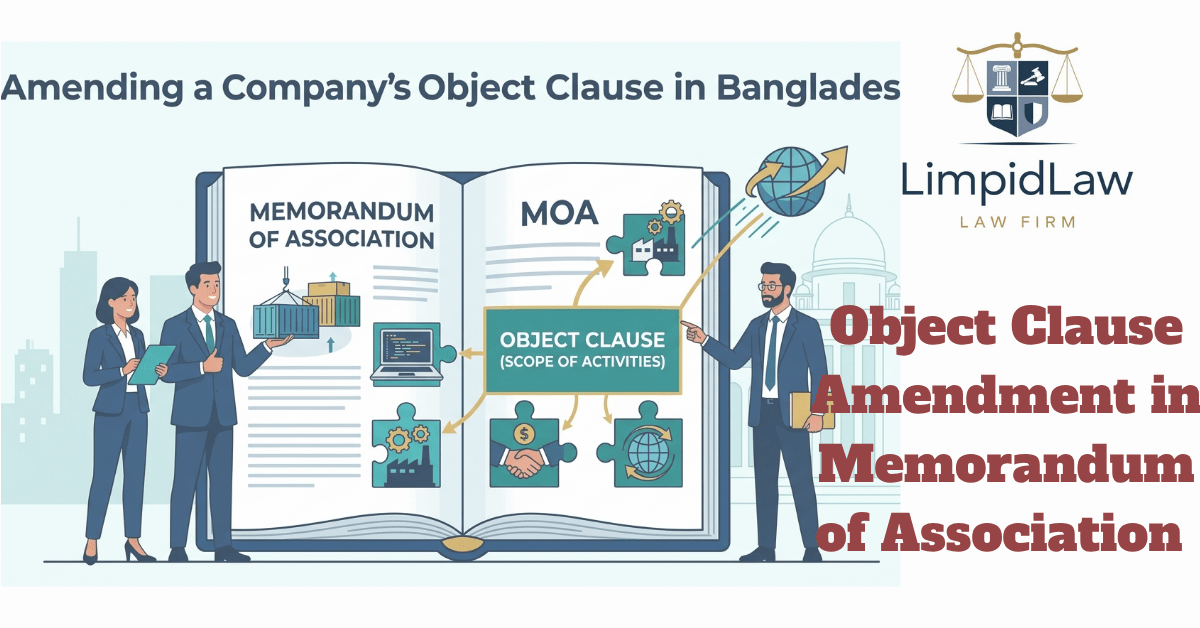
For any company, growth often means entering new markets, launching additional services, or diversifying business operations. However, a company in Bangladesh can only operate within the scope of activities mentioned in its Memorandum of Association (MoA), particularly the object clause. When a company wishes to carry on activities beyond those stated objects, it becomes necessary to amend the object clause legally. Under Sections 12 and 13 of the Companies Act, 1994, companies registered in Bangladesh may alter their object clause by passing a special resolution and obtaining confirmation from the High Court Division of the Supreme Court of Bangladesh.
What is an Object Clause in the MoA?
The object clause is one of the most important provisions of a company’s Memorandum of Association. It defines the purpose, scope, and nature of the business activities that the company is authorized to undertake. In simple terms, the object clause acts as a legal boundary for the company’s operations. If a company starts conducting activities outside those stated objects, such activities may become legally questionable. As businesses evolve, companies often need to update or expand their objects to reflect commercial realities. This is where amendment of the object clause becomes necessary.
Legal Basis for Alteration or Ammendment of Object Clause
Section 12 of the Companies Act, 1994 permits alteration of the object clause for specific purposes through a special resolution.
A company may amend its objects for the following reasons:
- To carry on business more efficiently or economically;
- To achieve its main purpose through improved or modern methods;
- To expand or change the geographical area of operations;
- To add a business that can conveniently be combined with existing operations;
- To restrict or abandon existing objects;
- To sell or dispose of the whole or part of the company’s undertaking; or
- To amalgamate with another company or organization.
Why Companies Amend Their Object Clause
In practice, companies usually seek amendment of the MoA for reasons such as:
- Expanding into new industries or sectors;
- Adding import, export, software, consultancy, manufacturing, or e-commerce activities;
- Restructuring business operations;
- Attracting investors or foreign partners;
- Complying with licensing or regulatory requirements; or
- Facilitating mergers and acquisitions.
Without updating the object clause, many regulatory authorities, banks, and business counterparties may refuse to recognize activities outside the stated business objects.
Procedure for Object Clause Amendment in Bangladesh
Below is the general legal procedure followed for amending the object clause of a company registered in Bangladesh.
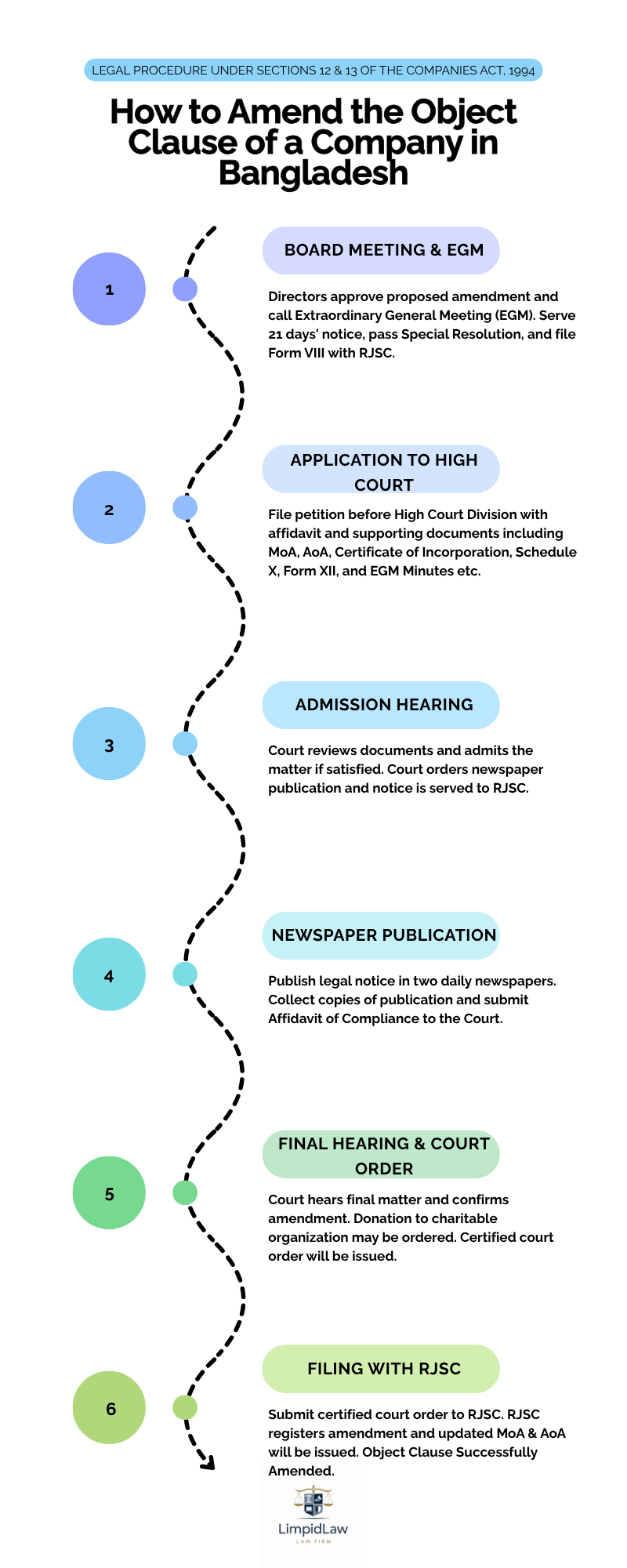
Step 1: Board Meeting and Extraordinary General Meeting (EGM)
The process begins with a board meeting where the directors approve the proposed alteration and decide to convene an Extraordinary General Meeting (EGM).
A notice of at least 21 days is generally required for the EGM unless shorter notice is consented to by the shareholders.
At the EGM, the shareholders must pass a special resolution approving the proposed amendment of the object clause.
After the resolution is passed, the company must file the return of special resolution with the Registrar of Joint Stock Companies and Firms (RJSC), along with the prescribed forms, including Form VIII.
Required Documents:
- Notice of Board Meeting;
- Board Resolution;
- Notice of EGM;
- Special Resolution;
- Certified copy of Form VIII.
Step 2: Filing Application Before the High Court Division
After passing the special resolution, the company must file an application before the Company Bench of the High Court Division of the Supreme Court of Bangladesh seeking confirmation of the alteration.
The application is usually supported by an affidavit and contains:
- Existing object clause;
- Proposed amended objects;
- Justification for the alteration; and
- Brief history of the company and shareholding structure.
Required Documents
- Application/Petition;
- Affidavit;
- Certificate of Incorporation;
- Certified copy of MoA and AoA;
- Latest Schedule X;
- Form XII;
- Notice and Minutes of EGM;
- Letter of Authorization letter (where applicable).
The Court’s confirmation is mandatory under Sections 12 and 13 of the Companies Act, 1994.
Step 3: Admission Hearing Before the Court
Once application filed, the matter receives a company matter number and is listed before the Company Bench.
At the admission hearing, the Court reviews the documents and may admit the matter if satisfied. If admitted then the Court, in respect of the admitted matter, generally directs to:
- Publish a legal notice in two specific daily newspapers (one Bangla and one English); and
- Serve a notice upon the RJSC.
Step 4: Publication of Legal Notice and Filing Affidavit of Compliance
Following the Court’s direction, legal notice must be published in said two designated daily newspapers.
After newspaper publication, an affidavit of compliance is required to be presented before the same High Court in stipulated time fixed by the Court and attaching copies of the newspaper publications as evidence of compliance.
Then the matter will be appeared in the daily cause list and will be fixed for final hearing.
Step 5: Final Hearing and Court Order
At the final hearing, the Court examines whether the alteration is lawful, commercially justified, and not prejudicial to creditors or shareholders.
If satisfied, the Court confirms the alteration wholly or partially and passes the final order under Section 13 of the Companies Act, 1994.
In practice, the Court may also direct the company to make a donation to a charitable institution before issuing the certified order. The court in practice, generally fix the donation amount and the charitable organization too.
After payment to pre decided charitable organization and submission of compliance to the Court, the certified copy of the final order will be ready to be obtained by the applicant company.
Step 6: Filing with RJSC
The final step is submission of the certified Court order along with the amended Memorandum and Articles of Association to the RJSC.
Upon registration, the RJSC issues the updated certified copies reflecting the amended object clause.
Under the Companies Act, the certified order and altered memorandum are required to be filed with the Registrar within the prescribed period as per section 15 of the Companies Act, 1994 .
Important Legal Considerations
Before applying for amendment of the object clause, companies should carefully consider the following:
- The proposed objects should be drafted clearly and broadly enough for future expansion;
- Regulatory approvals may be necessary for certain sectors such as finance, telecom, healthcare, or insurance;
- Existing contracts, licenses, and bank facilities should be reviewed;
- The amendment should align with the company’s long-term commercial strategy.
Professional legal drafting is extremely important because poorly drafted object clauses may create future operational or compliance difficulties.
Frequently Asked Questions (FAQs)
What is the object clause in a Memorandum of Association?
The object clause defines the business activities and purposes for which a company is formed. It determines the legal scope of the company’s operations.
Can a company change its object clause in Bangladesh?
Yes. A company may alter its object clause under Sections 12 and 13 of the Companies Act, 1994 by passing a special resolution and obtaining confirmation from the High Court Division.
Why would a company amend its object clause?
Companies usually amend their object clause to expand into new business sectors, add new services, restructure operations, enter new markets, or facilitate mergers and investments.
Is court approval mandatory for object clause amendment?
Yes. In Bangladesh, confirmation from the High Court Division is required for alteration of the object clause.
What type of resolution is required for amendment of the MoA?
A special resolution passed by shareholders in an Extraordinary General Meeting (EGM) is required.
How much notice is required for the EGM?
Generally, 21 days’ notice must be given unless shareholders consent to shorter notice.
What documents are required for object clause amendment?
Common documents include:
- Board Resolution;
- Special Resolution;
- Form VIII;
- MoA and AoA;
- Certificate of Incorporation;
- Schedule X;
- Form XII;
- Affidavit and Court Petition.
How long does the object clause amendment process take in Bangladesh?
The timeline varies depending on court schedules and compliance requirements. In practice, it may take several weeks to a few months.
Is newspaper publication necessary for object clause amendment?
Yes. After admission of the matter, the Court generally directs publication of legal notice in two daily newspapers.
What happens after the High Court approves the application of object clause amendment?
The certified Court order must be filed with the RJSC, after which the RJSC records the amendment and issues updated certified copies reflecting the amended object clause.
Can a company add multiple business activities through one amendment?
Yes. A company may add multiple business objects simultaneously, provided the proposed activities are lawful and properly drafted.
What is Form VIII in RJSC filing?
Form VIII is used for filing special resolutions with the RJSC after shareholder approval.
Does amendment of object clause affect existing business operations?
Usually no. The amendment mainly expands, modifies, or restricts the company’s authorized business activities.
Can foreign-owned companies amend their object clause in Bangladesh?
Yes. Foreign-owned or joint venture companies registered in Bangladesh may also amend their object clause following the same legal procedure.
What happens if a company operates outside its object clause?
Operating beyond the stated objects may expose the company to legal and regulatory complications, especially in licensing, banking, and contractual matters.
Conclusion
Amending the object clause of a company’s Memorandum of Association is a common yet significant corporate restructuring process in Bangladesh. As businesses grow and diversify, updating the MoA allows companies to legally expand operations, attract investment, and adapt to changing commercial realities. Although the process involves shareholder approval, High Court confirmation, newspaper publication, and RJSC filing, the procedure can be completed smoothly with proper legal guidance and documentation.
The content of this blog is for knowledge or information sharing purpose only and may not be relied on as legal advice. In terms of getting any legal help we always strongly advise to contact a professional lawyer. For professional legal help you can call or contact here.
Written By:
Sheikh Saiful Islam Rajib
Advocate, Supreme Court of Bangladesh