
For every company incorporated in Registrar of Joint Stock Companies and Firms (RJSC), holding an Annual General Meeting (AGM) is a fundamental legal obligation. The AGM is where shareholders review the company’s financial performance, appoint auditors, elect directors, and make key governance decisions.
Under the Companies Act, 1994, a company must hold an AGM every calendar year, and the gap between two AGMs cannot exceed 15 months. When a company misses this deadline, the default does not automatically invalidate the company’s status, but it can expose directors and officers to statutory penalties.
The good news there is a well-established remedy of Condonation of Delay in Holding AGM in Bangladesh. A company may apply to the High Court Division of the Supreme Court of Bangladesh to regularize the delay and obtain permission to hold the overdue AGM within a specified period.
This article explains the legal basis, required documents, court procedure, and practical considerations for obtaining such relief as well as the time extension for AGM in Bangladesh.
Why Holding an AGM Is Legally Important
An AGM serves several critical functions:
- Presentation and adoption of audited financial statements
- Appointment or reappointment of auditors
- Election or confirmation of directors
- Declaration of dividends (if any)
- Discussion of shareholder concerns
- Compliance with corporate governance obligations
Failure to hold an AGM may result in:
- Monetary penalties against responsible officers
- Difficulties in filing annual returns with RJSC
- Delays in obtaining bank financing or regulatory approvals
- Concerns from shareholders, investors, and auditors
Legal Framework Under the Companies Act, 1994
Section 81(2): Mandatory Annual General Meeting
The law requires every company to hold one AGM in each calendar year, with no more than fifteen months between one AGM and the next.
Section 85(3): Court’s Power in Case of Default
Where a company fails to hold its AGM in accordance with Section 81, the Court may direct that the meeting be convened and may issue all necessary ancillary directions.
Section 396: Jurisdiction of the High Court Division
This provision confirms that the High Court Division has broad authority to issue orders and directions necessary to enforce the Companies Act.
Together, these provisions empower the Court to condone the delay and authorize the company to hold the AGM within an extended timeframe.
Common Reasons for Delayed AGMs
The Court generally takes a practical approach when the delay is bona fide and properly explained. Typical reasons include:
- Internal management disputes
- Delay in completion of audited accounts
- Illness or unavailability of directors
- Regulatory investigations
- Force majeure events
- Banking or financial restructuring
- Pandemic-related disruptions
- Changes in shareholding or board composition
The key requirement is that the explanation must be genuine, reasonable, and supported by evidence where possible.
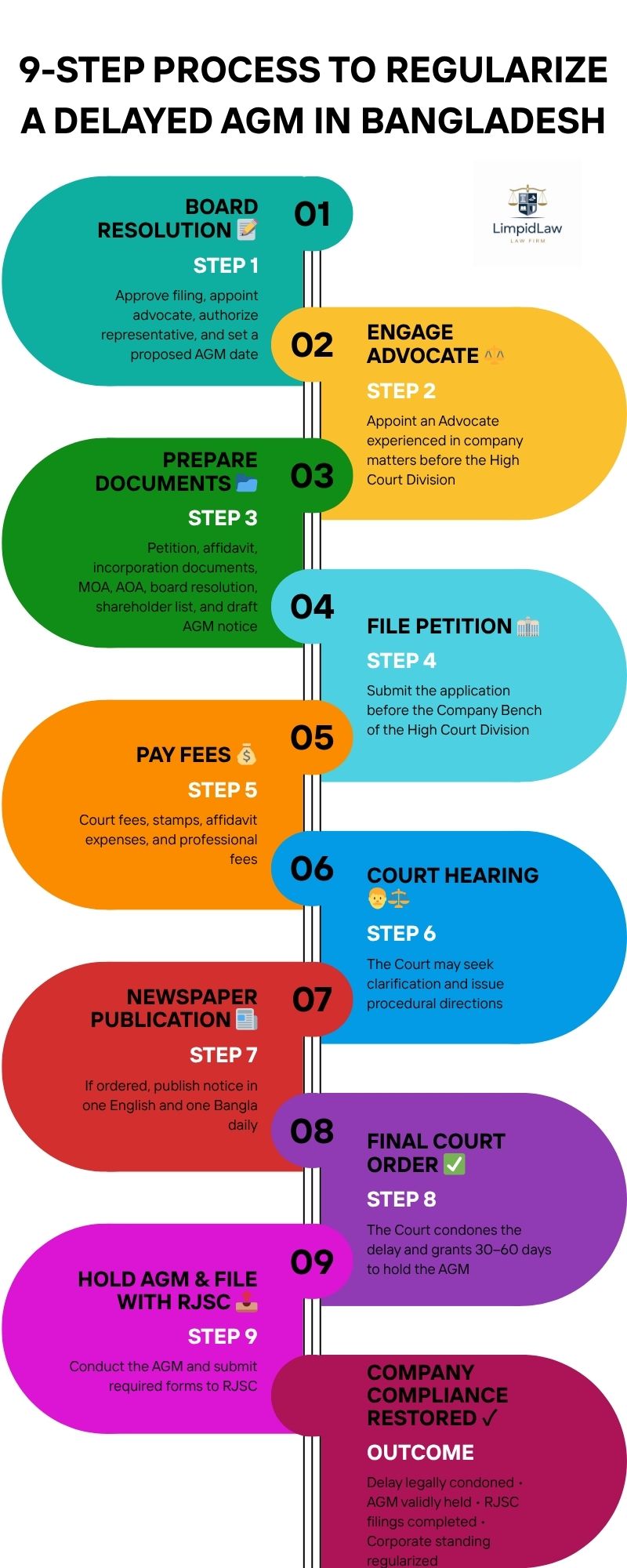
Step-by-Step Procedure for Filing the Application
Step 1: Pass a Board Resolution
The Board of Directors should formally authorize:
- Filing the application before the High Court Division
- Appointment of legal counsel
- Nomination of a company representative
- Proposed date for holding the overdue AGM
- Approval of the explanation for delay
Step 2: Engage an Advocate
A lawyer experienced in company matters should prepare and file the petition before the Company Bench of the High Court Division.
Step 3: Prepare Supporting Documents
The following documents are commonly required:
- Petition under Sections 81(2), 85(3), and 396
- Affidavit verifying the facts
- Certificate of Incorporation
- Memorandum and Articles of Association
- Board Resolution
- Latest audited accounts (if available)
- Previous AGM notice and minutes
- Updated shareholding list
- Draft AGM notice
- Vokalatnama
- Authorization letter in favor of a company representative
- Documents supporting the reasons for delay
Step 4: File the Petition
The petition is filed before the Company Bench of the High Court Division of the Supreme Court of Bangladesh.
Step 5: Pay Applicable Fees
This typically includes:
- Court fees and stamps
- Affidavit costs
- Professional legal fees
Step 6: Court Hearing
At the hearing, the Court may:
- Seek clarification on the cause of delay
- Issue an interim order
- Direct publication of a newspaper notice
- Fix a date for objections, if any
Step 7: Publish Newspaper Notice (If Ordered)
The Court may require publication in one English and one Bangla daily, informing interested persons of the application and inviting objections.
Step 8: Obtain the Final Order
If satisfied, the Court usually:
- Condones the delay
- Grants permission to hold the AGM
- Specifies a deadline, commonly 30 to 60 days
- Provides ancillary directions where necessary
Step 9: Hold the AGM and Complete RJSC Filings
After obtaining the Court order:
- Issue AGM notices
- Conduct the meeting
- Prepare minutes
- File relevant statutory forms with Registrar of Joint Stock Companies and Firms
Typical Relief Sought from the Court
A standard petition generally requests the Court to:
- Condone the delay in holding the AGM
- Permit the AGM to be held within a specified period
- Treat the meeting as valid despite the statutory default
- Grant any further directions necessary for compliance
Practical Tips for Companies:
- Apply as soon as the default is identified.
- Ensure financial statements are ready or substantially prepared.
- Keep the explanation factual and supported by documents.
- Coordinate with auditors before filing.
- Obtain certified copies of the Court order promptly.
- Hold the AGM strictly within the period specified by the Court.
Consequences of Ignoring the Delay:
Failure to regularize an overdue AGM can create ongoing compliance problems, including:
- Continuing statutory penalties
- Obstacles in annual return filings
- Questions from banks, investors, and regulators
- Increased exposure to shareholder disputes
Timely court intervention is usually the most efficient and legally secure solution.
Frequently Asked Questions (FAQs)
Can a company in Bangladesh hold an AGM after the legal deadline?
Yes. However, if the statutory deadline has already passed, the company should obtain permission from the High Court Division to regularize the delay and authorize a fresh date for the AGM.
Which court has jurisdiction over delayed AGM applications?
The Company Bench of the High Court Division of the Supreme Court of Bangladesh exercises jurisdiction under the Companies Act, 1994.
Under which sections is the application filed?
The application is commonly made under Sections 81(2), 85(3), and 396 of the Companies Act, 1994.
Who may file the application?
In practice, the company acts through its Board of Directors and authorized representative, assisted by an Advocate.
How long does the process usually take?
If documents are in order and no objections arise, the matter may be disposed of within a few hearings, often within several weeks.
Is newspaper publication always required?
No. Publication is only required if specifically directed by the Court.
What is the usual period granted by the Court to hold the AGM?
The Court commonly allows 30 to 60 days, though the exact period depends on the circumstances.
Can private limited companies also apply?
Yes. Both private and public companies are subject to AGM obligations and may seek appropriate relief when in default.
Will directors face penalties even after obtaining the order?
The Court’s order regularizes the default prospectively and significantly reduces compliance risks, although each case depends on its facts and regulatory context.
What documents are most important?
The Board Resolution, Petition, Affidavit, constitutional documents, shareholder list, and a clear explanation for the delay are essential.
Conclusion
Missing the deadline for an Annual General Meeting is a common corporate compliance issue, but it is one that can be effectively resolved through the High Court Division. With proper legal advice, complete documentation, and a transparent explanation, companies can regularize the default and restore full compliance with the Companies Act, 1994. If your company has failed to hold its AGM within the prescribed period, prompt legal action is advisable to avoid penalties and maintain confidence among shareholders, regulators, and business partners.
The content of this blog is for knowledge or information sharing purpose only and may not be relied on as legal advice. In terms of getting any legal help we always strongly advise to contact a professional lawyer. For professional legal help you can call or contact here.
Written By:
Sheikh Saiful Islam Rajib
Advocate, Supreme Court of Bangladesh