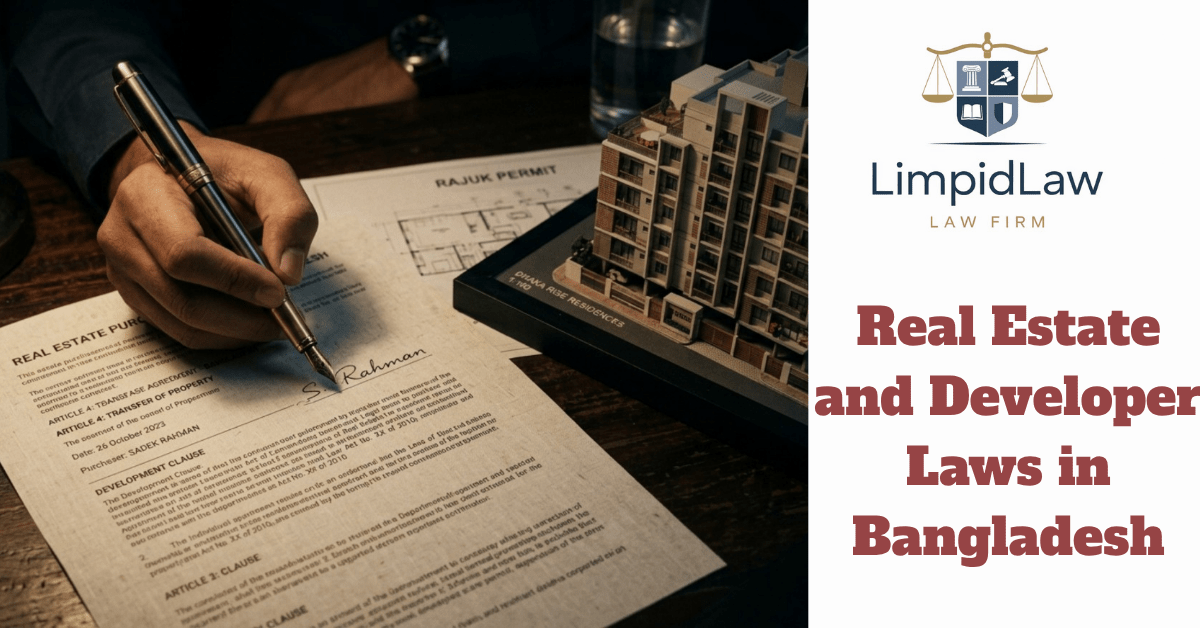
So, you’re thinking about buying your dream apartment or maybe even investing in a promising new project. The excitement is real! You’re scrolling through glossy brochures, imagining your life in that new space. But then, a niggling thought creeps in: “Is this… safe? What are my rights? What if something goes wrong?”. If you’ve ever had that thought, you’re not alone. The real estate market in Bangladesh is booming, but diving in without understanding the rules of the game is like building a house on sand. Let’s be honest, the legal side of things can feel like a maze of jargon and complicated paperwork. That’s why diving into the world of Real Estate and Developer laws in Bangladesh is not just smart, it’s essential. Understanding these laws helps protect your hard-earned money and ensures your dream home doesn’t turn into a legal nightmare.
The Cornerstone: Real Estate Development and Management Act, 2010
At the heart of the regulatory framework is the Real Estate Development and Management Act, 2010 (often just called the Real Estate Act). This is the key piece of legislation designed to bring transparency and accountability to the sector. Think of it as the ultimate rulebook for developers and a shield for buyers and landowners.
Key Provisions for a Smooth Transaction
The Act clearly outlines the responsibilities of developers, making sure buyers know exactly what they’re getting into.
Mandatory Registration: Developers must be registered with the relevant authority to conduct business. This is your first checkpoint! If a developer isn’t registered, walk away.
Project Approval and Disclosure: Before even selling an apartment or plot, the developer must have the approved design and plan from the appropriate authority (like RAJUK in Dhaka). The prospectus and allotment letter must include all project details, including the registration number and design approval.
No Unilateral Changes: A developer can’t change the agreed-upon design, size, or common facilities of a flat or plot without the written consent of the buyer. This prevents those frustrating last-minute surprises.
Timely Handover and Compensation: The Act sets a clear expectation for delivering the property. If the developer fails to hand over the real estate within the stipulated time, they are liable for compensation. Conversely, the buyer may be charged interest for late payments, but this is clearly regulated.
The existence of this act helps answer the question, What are real estate and developer laws in Bangladesh? They are a set of legal frameworks primarily aimed at regulating the real estate sector’s development, ensuring consumer protection, and promoting planned urbanization.
Other Key Legal Frameworks
- Apartment Ownership Act, 2000: This law establishes the status of apartment ownership as a transferable, heritable, and mortgageable property.
- It defines rights related to common areas, transfer of shares, and responsibilities of owners and associations.
- It establishes legal recourse for disputes and defines protections for purchasers of apartments.
- Building Construction Act, 1952 (amended): Applies to safe construction standards, urban planning, and the conduct of developers.
- Transfer of Property Act, 1882: Governs legal processes for transferring both moveable and immoveable property, including sale and mortgage.
Developer vs. Construction: A Crucial Comparison
While the Real Estate Act covers the business and transaction side of things, it’s important to distinguish it from real estate and construction law. They work hand-in-hand but have different focuses.
| Feature | Real Estate Development & Management Act, 2010 | Building Construction Act, 1952 & BNBC |
| Primary Focus | Regulating the developer-buyer/landowner relationship, project sales, financial transparency, and dispute resolution. | Regulating the physical structure, ensuring safety, approved designs, building materials, and structural integrity. |
| Key Authority | The Authority established under the Act (often delegated to existing bodies like RAJUK). | Local development authorities (RAJUK, CDA, KDA, etc.) and compliance with the Bangladesh National Building Code (BNBC). |
| What it Governs | Registration of developers, terms of sale contracts, handover dates, refunds, and penalties for non-compliance with the agreement. | Building height, land use zoning, structural stability, fire safety, and penalties for unauthorized construction. |
The two are interconnected: a developer must comply with Construction law in bd (like getting the right permits and following BNBC guidelines) before they can sell a property under the Real Estate Act. The Real Estate Act’s provisions on project approval directly link back to the technical requirements of the building codes.
Key Insights and Dynamic Implications
The dynamic between developers, buyers, and the law is constantly evolving, driven by urbanization and market demand. Here are a few essential insights:
Protecting the Buyer: Clarity in Contracts
The strongest implication for buyers is the mandatory clarity in all agreements. When you sign a contract for a flat, look for a few key things:
Full Disclosure: Does the agreement fully match the prospectus, especially regarding the unit size, materials used, and amenities? This adheres to the spirit of the real estate act Bangladesh.
Dispute Resolution: The Act encourages resolving disputes through arbitration before resorting to lengthy court battles, which is a faster, more effective mechanism for everyone involved.
Mortgaging Restrictions: Developers cannot mortgage the allotted plot or apartment after receiving a part or the full price from the buyer without obtaining the buyer’s express written consent. This is a critical safeguard against financial risk.
Due diligence is non-negotiable: Before buyers or investors commit, verifying the registration, approved plans, proper documentation (title, encumbrances) is essential. Real estate law in Bangladesh emphasises title verification and contract clarity.
Contracts matter more than ever: The JVA, POA, sales agreement all must reflect the legal obligations. For example, Section 10 of the Real Estate Act sets out the JVA and POA requirements.
Timely hand-over and utility readiness: One important clause is that the developer must hand over within a specified time and ensure utilities/amenities as outlined in the contract. Delay triggers compensation obligations.
Registration vs advertisement: The Act prohibits a developer from marketing/selling units before project approval and registration. That prevents speculative or risky pre-launch sales.
Navigating Joint Ventures: Landowner Rights
The real estate development law also significantly impacts landowners who partner with developers. These joint venture agreements are common, but the law ensures landowners are protected. Penalties exist for both the developer for delay and the landowner for prematurely canceling the power of attorney given to the developer.
The Developer’s New Reality: Mandatory Compliance
For developers, the legal landscape is stricter. The government is pushing for greater compliance with the building codes and the Real Estate Act. Penalties for construction deviation, such as building extra floors without approval, or engaging in real estate and developer laws in bd violations like misleading advertising, are significant and can include heavy fines and even imprisonment. The legal pressure aims to foster a more professional and ethical development culture.
Domestic versus Foreign/Inward investment
While not always tucked into every developer-law discussion, in real estate law in Bangladesh the rules for foreign investors differ (for example, restrictions on land ownership by non-citizens) and they must deal with additional compliance.
This distinction is important: while the “real estate development law” touches all projects, foreign-involved ones often trigger extra layers.
Red Flags and Green Lights: Navigating Your Investment Safely
Knowing the law is one thing; applying it during your search is another. Here’s a quick checklist to keep handy.
🚩 Major Red Flags (Walk Away!):
* “We’re just waiting for registration.” Never, ever pay a significant amount to an unregistered project.
* A vague or missing payment schedule. The contract should be crystal clear.
* Pressure to sign an agreement you haven’t read thoroughly.
* Unwillingness to show you the project’s official RERA registration documents.
* Prices that seem “too good to be true.”
✅ Green Lights (Proceed with Cautious Optimism):
* A developer with a strong, verifiable track record of completed projects.
* Full transparency with all legal documents and a clear, detailed purchase agreement.
* Willingness to answer all your questions and explain the contract clauses.
* Registration with RERA and all necessary approvals from RAJUK/City Corporation.
Frequently Asked Questions (FAQs)
We’ve compiled some common questions people have when dealing with the property market in Bangladesh.
Q. Can a developer legally take a mortgage on my apartment after I’ve paid for it?
A. No, not without your explicit written permission. Section 16 of the Real Estate Development and Management Act, 2010 strictly prohibits a developer from mortgaging a real estate property (plot or flat) after a part or the whole price has been paid by the purchaser, unless they have obtained the purchaser’s written consent.
Q. How can I verify if a developer has the necessary approvals?
A. You should ask the developer to provide a copy of the Approved Building Plan and the Land Use Clearance certificate, which is issued by the relevant authority like RAJUK, CDA, etc. This is a non-negotiable step in your due diligence process.
Q. What is the role of the Bangladesh National Building Code (BNBC) in construction?
A. The BNBC is the comprehensive set of technical standards that every construction project in the country must adhere to. It governs everything from structural safety, fire safety, electrical systems, and plumbing to ensuring earthquake resistance. Following the BNBC is mandatory for legal compliance.
Q. What are real estate and developer laws in Bangladesh?
A. In a nutshell, these are a set of rules and regulations, primarily governed by the Bangladesh Real Estate Development and Management Act, 2010, that control how residential projects are developed, marketed, and sold. They are designed to protect buyers from fraud and ensure developers follow standardized, ethical practices.
Q. What is the role of RERA?
A. The Real Estate Regulatory Authority (RERA), is the governing body established by the 2010 Act. Its job is to register developers and projects, approve building layouts, protect the interests of homebuyers, and handle disputes between buyers and developers. For example- Ministry of Housing and Public Works, RAJUK (in Dhaka), CDA (in Chattogram), and KDA (in Khulna) etc.
Q. What should I look for in my Purchase Agreement?
A. Your agreement is your bible. Scrutinize it for:
* The exact super-built-up and carpet area.
* A detailed, stage-by-stage payment schedule.
* The definitive date for possession (handover).
* A clause detailing what happens if the developer delays the project (compensation).
* A clear description of the finishes and amenities promised.
Q. What is the penalty for a developer who delays the handover of a flat?
A. According to the Real Estate Act, if a developer fails to hand over the property on the agreed date, they must pay compensation to the buyer at a rate specified in the agreement. If the agreement is silent on this, the Act stipulates a penalty rate of 15% annual simple interest on the deposited amount for the duration of the delay.
Q. Do real estate developers in Bangladesh need to register?
A. Yes — under the Act, a developer must obtain registration from the relevant authority for a specific area (or from the government for nationwide business) before conducting real estate business.
Q. Is it safe to buy a flat in an unregistered project?
A. It is highly risky and not recommended. An unregistered project has not been vetted by the authorities, meaning there is no guarantee about the legality of the land, the approval of the design, or the security of your funds. Always insist on seeing the RERA registration.
Q. How does the law protect my investment money?
A. The law mandates that developers deposit all money collected from buyers for a specific project into a separate bank account. This money must be used only for the construction and development costs of that project, preventing misuse and reducing the risk of the project being abandoned due to a funds shortage.
Q. What is the Real Estate Development and Management Act 2010?
A. It’s the principal legislation in Bangladesh that regulates private real estate developments. It defines terms like “real estate”, “developer”, “project”, and sets out registration of developers, duties, sale rules, hand-over obligations, penalties for non-compliance, etc.
Q. What kinds of contracts should a landowner and developer sign?
A. They typically sign a Joint Venture Agreement (JVA) and a Power of Attorney (POA). The JVA defines shares, duties, schedule, etc; the POA allows the developer to act on behalf of the landowner for plan approvals and sales.
Q. Is it legal for a developer to sell apartments before approval is granted?
A. No — the Act prohibits a developer from advertising or selling real estate before obtaining project approval and before fulfilling the registration requirements.
Q. Can a developer take a unit or plot as security (mortgage) before handover?
A. No — the law prohibits a developer from selling a unit that has been mortgaged to a bank or other financial institution without releasing it, before the handover and registration.
Q. What are major risks for international investors in Bangladesh real estate?
A. Some risks include: unclear title or ownership, missing approvals/registration, developers not adhering to building codes (construction law in BD), delays, lack of transparency, foreign-ownership restrictions. Being advised by experience lawyer properly anyone can mitigate the said risk factors.
Q. How does construction law tie into real estate law in Bangladesh?
A. While real estate law covers the development/sale/transfer of property, construction law (or the construction dimension) like the Building Construction Act 1952, the BNBC, etc., covers the physical building process — the plan approval, structural safety, utilities. These intersect heavily.
Your Blueprint for a Safe Investment
Buying a home is exciting, and knowing your rights under the real estate and developer laws in Bangladesh is your best protection. The law is designed to balance the interests of all parties—buyers, landowners, and developers—by promoting professionalism and accountability.
The bottom line? Do your homework or get professional legal help. Verify the developer’s registration, scrutinize the contract, and ensure all construction adheres to the approved plans and BNBC. A little legal knowledge goes a long way in turning your property dream into a reality without the accompanying legal headaches. Your property investment is likely one of the most significant financial decisions you’ll ever make. Don’t let excitement cloud your judgment. Ask the tough questions and ensure that the developer is playing by the rules. By understanding real estate and developer laws in bd, you’re not just buying bricks and mortar; you’re investing with confidence and securing your peace of mind.
The content of this blog is for knowledge or information sharing purpose only and may not be relied on as legal advice. In terms of getting any legal help we always strongly advise to contact a professional lawyer. For professional legal help you can call or contact here.
Written By:
Sheikh Saiful Islam Rajib
Advocate, Supreme Court of Bangladesh