Introduction
Facing a criminal case can be stressful, particularly when there is a risk of arrest or the accused is already in custody. In such circumstances, obtaining bail from the High Court Division of the Supreme Court of Bangladesh may provide an important legal remedy. However, many people are unfamiliar with the legal requirements, application process and practical steps involved. Understanding How to get high court bail can help an accused person and their family make informed decisions and seek appropriate legal assistance.
In Bangladesh, the High Court Division has the authority to grant bail in appropriate cases under Section 498 of the Code of Criminal Procedure, 1898 (CrPC). However, bail is not automatic. The Court considers the nature of the offence, the allegations, the available materials, the stage of the case and other relevant circumstances before making a decision.
This guide explains the High Court bail procedure, the documents required, the approximate time involved and what happens after bail is granted.
What is High Court Bail?
High Court bail refers to the release of an accused person from custody, or protection from arrest in appropriate circumstances, under an order passed by the High Court Division.
Under Section 498 of the Code of Criminal Procedure, 1898, the High Court Division and the Court of Session have the authority to direct that a person be admitted to bail or that an existing bail amount be reduced.
In simple terms, when an accused person cannot obtain appropriate relief from the lower court, they may approach the High Court Division for bail, subject to the applicable law and circumstances of the case.
It is important to understand that the High Court Division does not grant bail in every criminal case. The decision depends on judicial discretion and the merits of the particular application.
| Sessions Court | High Court | |
| Usual starting point? | Yes, in most cases | Usually after rejection, or in exceptional cases |
| Power to grant regular bail | Yes | Yes (concurrent) |
| Speed | Often quicker to list | Depends on the court’s backlog |
| Best for | First-time applications | Appeals against rejection, serious or complex cases |
Types of Bail Available from the High Court Division
Before filing an application, it is important to understand which type of bail is appropriate. There are two types:
Regular Bail
Regular bail is generally sought when an accused person has already been arrested or is in custody. The accused may approach the appropriate court seeking release on bail.
If bail is refused by the lower courts, an application may be filed before the High Court Division under Section 498 of the CrPC, subject to the applicable legal framework.
Anticipatory Bail
Anticipatory bail is sought when a person reasonably apprehends arrest in connection with a non-bailable offence.
The High Court Division may, in exceptional circumstances, grant temporary protection from arrest. However, Bangladeshi courts have repeatedly emphasized that anticipatory bail should not become indefinite protection or interfere with a fair investigation.
The Supreme Court has recognized that anticipatory bail should ordinarily not continue beyond eight weeks and should not continue after submission of the police report. The facts and applicable judicial directions must always be considered.
Which one should you apply for?
– If the accused has already been arrested, regular bail is generally the relevant remedy.
– If the accused apprehends arrest, anticipatory bail may be considered in exceptional circumstances.
– If bail has already been granted but the conditions are excessive, an application for reduction of bail may be appropriate.
High Court Bail Procedure in Bangladesh: Step-by-Step Guide
The High Court Bail Procedure generally involves preparing a criminal miscellaneous application, filing it before the appropriate Bench of the High Court Division and presenting legal arguments in support of the accused’s release.
Here is how the process usually works.
Step 1: Consult an Experienced Criminal Lawyer
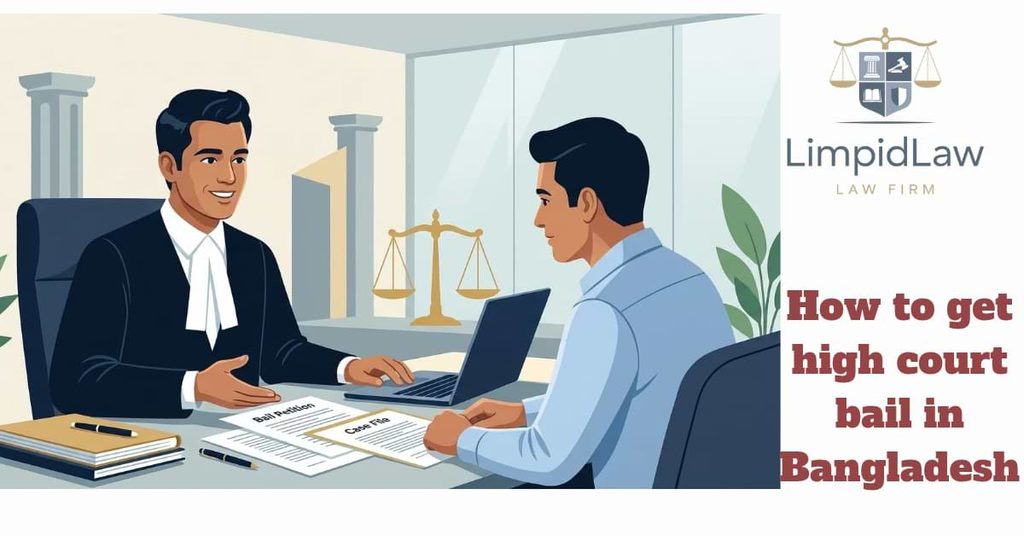
The first step is to consult a lawyer experienced in criminal litigation before the High Court Division.
The lawyer will examine the FIR, relevant case records, allegations and previous bail orders to determine whether approaching the High Court is appropriate.
Step 2: Apply for Bail Before the Appropriate Lower Court
In ordinary circumstances, an accused person should first seek bail before the appropriate Magistrate or trial court. If the application is rejected, the accused may approach the Court of Session and, where appropriate, subsequently approach the High Court Division.
This is the usual progression, although special laws, jurisdictional issues and exceptional circumstances may affect the appropriate procedure.
Step 3: Prepare the High Court Bail Application
Once the appropriate legal grounds have been established, the lawyer prepares the High Court Bail application.
The application generally includes:
– Name and particulars of the accused.
– FIR or complaint case number.
– Relevant police station and court details.
– Nature of the alleged offence.
– Brief facts and circumstances of the case.
– Previous bail applications and orders.
– Legal grounds supporting the bail prayer.
– Specific relief requested from the Court.
The application should clearly explain why the accused deserves bail and address any concerns regarding absconding, interference with witnesses or obstruction of the investigation.
Step 4: Collect and Attach Supporting Documents
Proper documentation is essential. Depending on the circumstances, the following documents may be required:
- Copy of the FIR or complaint.
- Copy of the relevant lower court orders rejecting bail.
- Copy of the charge sheet, if submitted.
- Relevant case documents and supporting materials.
- Petition supported by an affidavit.
- Vakalatnama authorising the lawyer to represent the accused.
Additional documents may be necessary depending on the nature of the case and the applicable procedural requirements.
Step 5: File the Application Before the High Court Division
After preparing the application and supporting documents, the lawyer files it before the appropriate filing section of the High Court Division.
The application is ordinarily registered as a Criminal Miscellaneous case and assigned a case number.
The matter is then placed before an appropriate Bench for consideration.
Step 6: Hearing Before the High Court Division
During the hearing, the lawyer presents the facts, legal grounds and relevant circumstances supporting the bail application.
The Court may consider:
– Whether the allegations are supported by prima facie evidence.
– The seriousness and nature of the alleged offence.
– The specific role attributed to the accused.
– Whether the accused is likely to abscond.
– Whether there is a possibility of influencing witnesses or interfering with the investigation.
– The accused person’s personal circumstances and relevant medical conditions.
– The stage of investigation or trial.
– Any other relevant legal and factual considerations.
The prosecution may oppose the application. After considering the submissions of both sides, the Court may grant bail, reject the application or pass an appropriate conditional order.
Step 7: Comply With the Court’s Conditions
If the Court grants bail, the accused must comply with the conditions specified in the order.
These may include executing a bail bond, furnishing sureties, appearing before the concerned court and cooperating with the investigation.
Under Sections 499 and 500 of the CrPC, execution of the required bond and communication of the release order are important steps before release from custody.
How to Get Regular Bail From High Court: Important Considerations
If the accused is already in custody, the application should focus on the circumstances that justify release.
For example, the defence may argue that:
– The accused has been falsely implicated.
– The allegations do not establish a strong prima facie case.
– The accused has already spent a substantial period in custody.
– The investigation has progressed sufficiently.
– The accused has no history of absconding.
– Continued detention is unnecessary in the circumstances.
However, none of these grounds automatically guarantees bail. The Court examines the overall facts, applicable legislation and judicial precedents.
How Long Does It Take to Get Bail From the High Court?
One of the most common concerns of accused persons and their families is the time required to obtain bail.
There is no fixed statutory period within which the High Court Division must decide every bail application.
The time depends on several factors, including:
– Availability of the appropriate Bench.
– Court workload and hearing schedules.
– Completeness of the application and supporting documents.
– Whether the prosecution needs time to obtain instructions or to file its reply.
– Complexity and seriousness of the allegations.
– Whether the matter is contested or requires further consideration.
– Adjournments requested by either side
In straightforward matters, an application may be heard relatively quickly. Other cases may require several hearings or take considerably longer.
It is therefore difficult to provide a guaranteed timeline.
What Happens After Getting Bail From the High Court?
Getting a favourable bail order does not always mean that the accused will be released immediately.
The Procedure after getting bail from high court generally involves the following steps:
- Obtain the relevant bail order from the High Court Division.
- Complete the necessary documentation and obtain the required certified copy or authenticated order, as applicable.
- Submit the order before the concerned lower court or authority in accordance with its directions.
- Execute the bail bond and arrange acceptable sureties, where required.
- Ensure that the release order is communicated to the jail authority if the accused is in custody.
- Confirm that no other legal detention order or warrant prevents release.
Under Section 500 of the CrPC, the jail authority is required to release the accused upon receiving the appropriate release order after execution of the bond.
Important: If the accused is facing multiple criminal cases, obtaining bail in one case does not automatically secure release if detention is required in another case.
Conclusion
Obtaining bail from the High Court Division of the Supreme Court of Bangladesh involves more than simply submitting an application. The strength of the legal grounds, accuracy of the supporting documents, applicable laws and effective presentation before the Court all play important roles.
If you or a family member is facing a criminal case, it is advisable to consult an experienced criminal lawyer at an early stage. A lawyer can examine the case, identify the appropriate legal remedy and guide you through the process of seeking bail.
Remember, every criminal case is different, and the decision to grant or refuse bail rests with the Court.
Frequently Asked Questions (FAQs)
Q. How to apply bail in high court?
A. An accused person may apply for bail before the High Court Division through a properly prepared criminal miscellaneous application under Section 498 of the CrPC, where applicable. The application should include relevant case documents, previous bail orders, an affidavit and appropriate legal grounds.
Q. How much time it takes to get bail from high court?
A. There is no fixed timeframe. Some applications may be heard within a few working days, while others may take several weeks or longer, depending on the Court’s schedule, case complexity and prosecution’s response.
Q. How many days it takes to get bail from high court?
A. The number of days varies from case to case. Filing an application does not guarantee an immediate hearing or a favourable order. The lawyer should monitor the case listing and communicate any developments.
Q. How much time it takes to get bail from Supreme court?
A. The High Court Division is one of the two divisions of the Supreme Court of Bangladesh. Most ordinary applications for bail at the higher-court level are considered by the High Court Division. The Appellate Division is not ordinarily the first forum for a bail application. Time requirements depend on the nature of the proceedings.
Q. How many days for bail in high court after the hearing?
A. If bail is granted, the next steps involve obtaining the necessary order, completing the bail bond formalities and communicating the release order to the relevant authority. Actual release may take additional time depending on documentation and administrative procedures.
Q. How to get high court bail order copy?
A. After the Court passes a bail order, the concerned lawyer can take steps to obtain the order copy through the appropriate copying procedure. The Supreme Court also provides an online facility for downloading an applicant’s copy through its [Applicant’s Copy Portal]
The availability of an applicant’s copy and the requirements for obtaining a certified copy are not necessarily the same. The lawyer should confirm which version is required for the next legal step.
Q. Can the High Court grant bail if the lower court rejects the application?
A. Yes. The High Court Division has the authority under Section 498 of the CrPC to grant bail in appropriate cases, even where the lower court has rejected the application. However, the accused must establish sufficient legal grounds for obtaining such relief.
Q. Can the High Court cancel bail once granted?
A. Yes. Bail is not an unconditional or permanent right in every case. The Court may cancel bail in appropriate circumstances, including misuse of bail privileges, violation of conditions, interference with witnesses or attempts to obstruct justice.
Q. Is it necessary to surrender before the lower court after obtaining anticipatory bail?
A. Generally, yes. Anticipatory bail is ordinarily temporary and subject to the directions of the High Court Division. The accused is generally required to surrender before the appropriate lower court within the period specified in the order and seek regular bail.
Q. What happens if the High Court rejects a bail application?
A. If the High Court Division rejects a bail application, the accused may consider available legal remedies, including approaching the Appellate Division where legally appropriate, or filing a fresh bail application before the competent court if there are changed circumstances or new grounds such as a completed investigation or a filed chargesheet.
Q. Can a person get bail from the High Court without a lawyer?
A. Although an accused person may have certain rights to appear and conduct proceedings personally, High Court criminal proceedings involve specific legal and procedural requirements. Professional legal representation is strongly advisable.
Q. What documents are required for a High Court bail application?
A. Generally, the required documents include the FIR, lower court bail rejection orders, relevant case records, charge sheet (if available), affidavit and vakalatnama. Additional documents may be required depending on the case.
Q. What is the difference between regular and anticipatory bail?
A. Regular bail applies after arrest. Anticipatory bail is sought before arrest, to avoid being taken into custody.
Q. Why am I still in jail after the bail order?
A. Usually because the bond, surety verification or communication to the jail is pending. Sort these immediately.
Q. How to Get Regular Bail from High Court When the Lower Court Said No
A. Rejection by the Sessions Court isn’t the end. How to get regular bail from high court after a rejection comes down to showing what has changed or what the lower court missed: a completed investigation, a filed chargesheet, weak evidence, or a long period already spent in custody. A fresh, honest argument beats repeating the old one.
The same logic applies to how to get bail from high court case situations involving serious offences. Preparation and clarity matter more than dramatics.
Q. Quick Compare: High Court vs Supreme Court Timelines
A. How much time it takes to get bail from Supreme court is even harder to pin down. There is no fixed number. It depends on when your special leave petition is listed and how urgent the Court finds the matter. Realistically, think of the Supreme Court as a last resort after the High Court, not a shortcut.
The content of this blog is for knowledge or information sharing purpose only and may not be relied on as legal advice. In terms of getting any legal help we always strongly advise to contact a professional lawyer. For professional legal help you can call +8801753178887 (whatsapp) or contact here.
Written By:
Sheikh Saiful Islam Rajib
Advocate, Supreme Court of Bangladesh