Introduction
If you’ve ever asked yourself “How does Muslim Inheritance Law in Bangladesh work?,” you’re in the right place. Whether you’re a family member, a legal professional, or simply curious, understanding the rules around Muslim succession in Bangladesh is essential. In this blog post we’ll unpack how inheritance under Muslim law operates in Bangladesh — covering everything from the basics to key comparisons, implications, and real-life insights. We’ll keep things conversational and straightforward, so hang tight!
What Makes Bangladesh’s Inheritance System Unique?
Here’s something interesting: Bangladesh doesn’t have one universal inheritance law for everyone. Instead, your religion determines how your property gets distributed after death. If you’re Muslim (and about 90% of Bangladeshis are), muslim succession law in Bangladesh follows Islamic Shariah principles, specifically the Hanafi school of jurisprudence.
This system, rooted in the Quran and enriched through Hadith and Ijma (scholarly consensus), operates quite differently from what you might see in Western countries. The moment a Muslim person dies, their heirs automatically gain rights to shares in the property—no waiting, no ambiguity about who qualifies as an heir.
Muslim inheritance law in Bangladesh is governed primarily by Islamic Sharia (as interpreted under local law), the Muslim Family Laws Ordinance of 1961, and relevant sections of the Succession Act of 1925.
Legal Foundation and Principles
Before we dive into the Bangladeshi context, let’s start with the source. So, what is inheritance law in Islam? Muslim inheritance adheres strictly to Quranic directives, Hadith/the Sunnah (teachings of the Prophet Muhammad), and consensus from Islamic scholars. Bangladesh recognizes these laws for its Muslim citizens, ensuring property is distributed among legal heirs—spouse, children, parents, and, in some cases, siblings and grandchildren.
What is inheritance law for Muslims in Bangladesh?
The inheritance practices for Muslims in Bangladesh are governed by a blend of traditional Islamic principles (Shariah) and statutory frameworks. Broadly speaking:
- The law treats “inheritance” or succession as the process by which someone’s property passes to heirs after their death. For Muslims in Bangladesh, this means their deceased estate is distributed in line with what’s often called the “Hanafi law of inheritance” (a Sunni school) plus the local adaptations.
- Key legislation includes the Muslim Family Laws Ordinance, 1961, the Muslim Personal Law (Shariat) Application Act, 1937 and the Succession Act, 1925.
- The system is often referred to as the “Muslim succession law in Bangladesh” or simply “Muslim inheritance laws” in Bangladesh.
So when you hear phrases like “Bangladesh Muslim inheritance law” or “Muslim property inheritance law”, they generally point to this combined framework of Sharia-based rights plus Bangladeshi statute.
Key features of the system
Here are some of the most important features of how the system works — think of them as the rules of the game:
1. Fixed shares (for the “sharers”)
Certain close heirs (wife, husband, parents, children) are entitled to predetermined shares of the deceased’s estate — these are known as sharers.
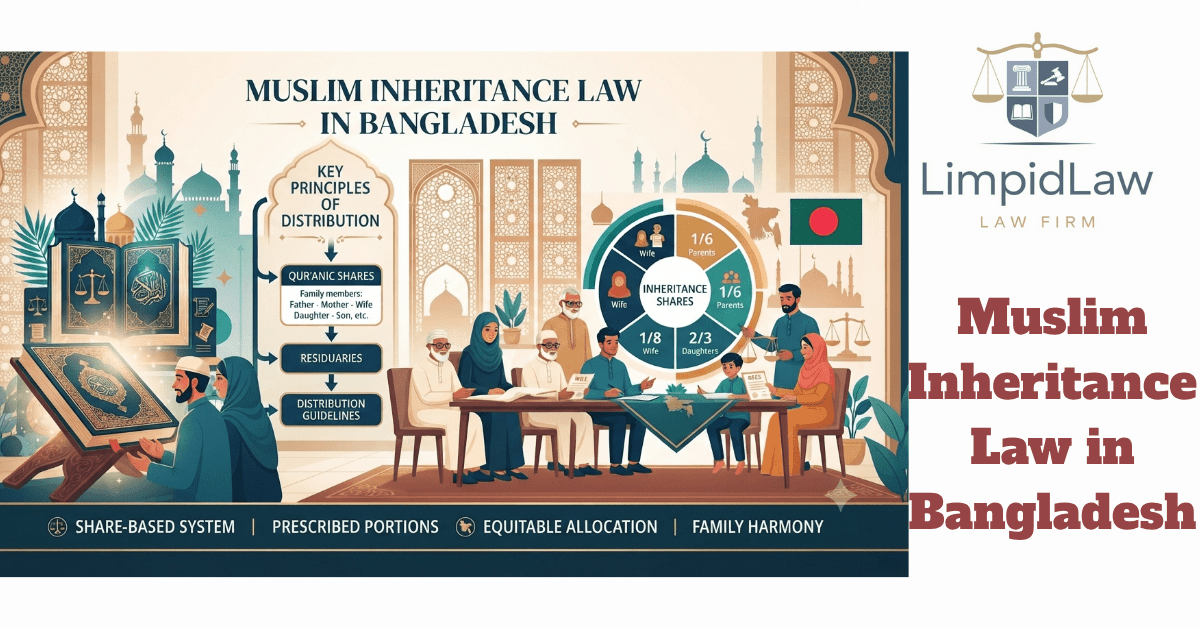
- Spouse: If the deceased leaves children, the wife receives 1/8 (one-eighth) of the estate; if no children then it is 1/4(one-fourth). Conversely, the husband gets one-fourth if his wife leaves children, and one-half if she does not.
- Children: Sons and daughters are principal heirs. Sons generally receive twice the share of daughters (i.e., a 2:1 ratio). For example, if there are two sons and one daughter, the estate is divided into 5 shares: each son gets 2 shares, the daughter gets 1.
- Parents (Islamic inheritance from mother and father): If the deceased leaves children (or son’s children) or two or more siblings, the mother gets 1/6(one-sixth),If there are no children and fewer siblings, the mother may get 1/3 (one-third).The father’s share varies depending on the number of heirs but is also at least one-sixth.
- Grandchildren and Other Heirs: If a child predeceases the parent, his or her own children (the deceased’s grandchildren) may inherit their parent’s share under the 1961 Ordinance.
- Daughters: If only daughters are present without son, a single daughter gets 1/2 (half) of the estate, while more than one daughter and no son, they jointly get 2/3(two-thirds) of the whole estate.
- Siblings: If there are no children, spouse, or parents, siblings inherit, with brothers receiving twice what sisters get.
2. Intestate succession & wills
- If someone dies without a will, the property goes to heirs under the prescribed rules.
- A Muslim in Bangladesh may make a will (wasiyyah), but the amount they can bequeath to non-heirs is limited to one-third of their estate — the rest must abide by the fixed share system.
3. Residual and distant heirs
- Once sharers get their share, if there’s leftover property, it may go to residuaries (heirs who fill the “balance”) or distant kindred (more remote relatives).
- The classification is often: Sharers → Residuaries → Distant Kindred.
4. Religious basis
The system draws on the Qur’an, Sunnah and the recognized Islamic legal methods (Ijma, Qiyas) and then is applied via Bangladeshi law in Muslim succession cases.
5. Application to land, property & other assets
- Land, property & other assets is subject to this law, and the statute clarifies that property of a deceased person in Bangladesh is regulated by Bangladesh law no matter where the person domiciled.
- Family land distribution law in Bangladesh intersects with this framework when the deceased is Muslim.
Key Points
- Shares are allocated by gender and degree of relationship, but also reflect financial responsibilities within the family.
- Testamentary freedom is limited; only one-third may be bequeathed outside the mandated heirs.
- Denial of a daughter’s share or other legal heir’s rights is contrary to law and can be challenged.
Muslim inheritance law in Bangladesh is designed to maintain family stability and preserve justice by ensuring every eligible relative receives their Quranic-mandated portion of any estate.
Implications & insights for families
If you are part of a family, legal practitioner or someone drafting estate plans in Bangladesh, here are some key take-aways:
- Know your shares: For example, if a Muslim parent dies leaving children, wife and parents, you’ll want to know how shares (wife’s 1/8, mother’s 1/6 etc.) play out.
- Be clear about a will: Because only up to one-third of estate can be freely willed to non-heirs, families must realize that heirs’ statutory shares take priority.
- Women’s awareness: While daughters, mothers and wives are inheritors, they often receive less (e.g., daughters half of what sons get).
- Land & family assets complications: Especially in family land situations, disputes can arise if documentation is unclear. Early planning helps.
- If no will or no heirs: The law provides for property to go to residuaries or distant kindred — so even if immediate heirs are lacking, there’s a framework.
- For international clients: If a Muslim client lives abroad but owns property in Bangladesh, you must consider Bangladeshi Muslim inheritance law (intestate or via will) for that property.
- Land/documentation issues: title clearance, succession certificates, identification of heirs are key. Procedures under the Succession Act 1925 may apply.
- Dispute resolution and mediation: Given the structured nature of the system, disputes often revolve around claims for residuary shares, step-relatives, or contesting wills beyond permitted limits.
Why this matters and potential challenges
- Legal certainty: Clear legal shares reduce ambiguity and can help prevent long-running family disputes.
- Gender equity concerns: Some argue that the rule of sons getting double a daughter’s share conflicts with modern equality principles.
- Documentation issues: In many rural or informal settings, property transfers aren’t well documented, leading to conflict.
- Will misunderstanding: People may assume they can will their entire estate freely, but the one-third limit is crucial.
- Cross-border & foreign nationals: If the deceased owned assets abroad, or was a dual national, things get more complex (applicable law may vary).
Frequently Asked Questions
Here are some commonly asked questions about inheritance under Muslim law in Bangladesh:
Q: What happens under Muslim succession law in Bangladesh if someone dies without a will?
A: If a Muslim dies intestate (without a will) in Bangladesh, their entire estate is distributed according to Islamic inheritance law (faraid). The property automatically transfers to legal heirs based on their fixed shares as prescribed by the Quran. The distribution follows a specific sequence: first, funeral expenses and debts are paid, then the remaining estate is divided among Quranic partners, residuaries, and distant kindred in that order.
Q: Can someone give all their property to whoever they like under the inheritance law of Bangladesh?
A: Not fully. Under Muslim law of inheritance in Bangladesh, a Muslim may only bequeath (via will) up to one-third of the estate to non-heirs. The remaining two-thirds must go to the legal heirs (sharers/residuaries).
Q: What is the wife’s share in Islamic inheritance law for wife in Bangladesh?
A3: If the deceased leaves children, the wife gets 1/8 of the estate. If there are no children, she gets 1/4 under the system. If the deceased had multiple wives, they share this portion equally among themselves.
Q: Does the daughter get equal share as the son under Bangladesh Muslim inheritance law? Or How is a daughter’s share different from a son’s?
A: No, not necessarily. When a son and daughter both exist, the son receives twice the share of the daughter (i.e., ratio of 2:1) under the Muslim law of inheritance in Bangladesh.
Q: What is the share of the mother under Muslim property inheritance law?
A: If the deceased has children (or a son’s child) or two or more siblings present, the mother’s share is 1/6. If no children and fewer siblings, her share may be 1/3.
Q: How does family land distribution law in Bangladesh affect Muslim inheritance?
A: Family land is treated like other property under inheritance. But due to familial and cultural contexts (joint family holdings, ancestral land), distribution may involve additional steps, documentation or mediation. Clear title, estate planning and knowledge of the fixed share rules help reduce conflict.
Q: What should a law firm advising an international client look out for?
A: They should consider: (a) whether the deceased had made a valid will and whether it complies with the one-third rule; (b) whether property is in Bangladesh and thus falls under Bangladesh Muslim inheritance law; (c) identify all heirs as per sharer/residuary classifications; (d) ensure debts/funeral expenses are cleared before division.
Q: What is the difference between inherited property and property received as dower?
A: These are completely separate categories. Dower (mahr) is an amount paid by the husband to the wife at the time of marriage as her exclusive right—it’s her property during the marriage. Inheritance, however, is what you receive from a deceased relative’s estate according to fixed shares. Both belong to the woman entirely, and she has complete freedom to use, invest, or dispose of both as she wishes.
Q: Can a Muslim father completely disinherit his daughter in Bangladesh?
A: No, absolutely not. Under Islamic inheritance law as applied in Bangladesh, you cannot disinherit a legal heir. A daughter has an automatic, irrevocable right to her share of inheritance. Even a will attempting to exclude her would be invalid. This protection exists specifically to prevent parents from unfairly depriving children of their rightful inheritance due to anger, preference for other children, or societal pressure.
Q: Can a Muslim in Bangladesh write a will?
A: Yes, absolutely. A Muslim can write a will (Wasiyat) for up to one-third of their net estate (after paying funeral expenses and debts) without the consent of the legal heirs. This one-third can be given to anyone, including people who are not legal heirs under Islamic law. To bequeath more than one-third, the consent of the legal heirs is required after the death of the testator.
Q: What is the difference between Sunni and Shia inheritance rules in Bangladesh? Or, Can inheritance laws be different for Shia Muslims in Bangladesh?
A: While the majority of Bangladeshi Muslims follow the Hanafi (Sunni) school of thought, there is a Shia minority. The shares can differ significantly. For example, under Shia law, a daughter can exclude a full brother from inheritance, which is not the case under Sunni law. It’s crucial to identify which school of thought applies.
Q: What if the only heir is a single daughter?
A: If a person passes away and their only heir is one daughter, she would receive half of the estate as her fixed Quranic share. The remaining half would be distributed to other distant relatives according to the rules of succession.
Q: Do these laws apply to all types of property?
A: Yes, the Muslim property inheritance law applies to all forms of assets—land, buildings, bank accounts, investments, and personal belongings. The entire estate is pooled together, debts and funeral costs are paid, and then the shares are distributed from the remainder.
Q: What steps should we take after a death to handle inheritance?
A: First, focus on the funeral and burial. After the emotional initial period, the family should:
* Gather all asset and liability information.
* Calculate the net estate.
* Identify all legal heirs.
* Calculate each heir’s specific share according to Islamic law.
Get a professional legal help for lawyer, if necessary for the above and any other relevant tasks. For example: the transfer of land and other titled assets etc.
Q: Do grandchildren inherit if their parent dies before the grandparent?
A: Yes, thanks to the Muslim Family Law Ordinance of 1961. If your son or daughter dies before you, their children (your grandchildren) are not excluded from inheritance. They receive the share that their deceased parent would have gotten if alive.
Q: Can a Muslim make a will that gives all property to one child?
A: No. Islamic inheritance law in Bangladesh imposes strict limitations on wills: you can only bequeath up to one-third of your net estate (after debts). This rule prevent favoritism and ensure fair distribution among all heirs.
Q: What documents do I need to claim my inheritance?
A: You’ll need several documents: proof of death (death certificate), relationship proof (birth certificate, marriage certificate, family documents), a Warishan certificate from the Union Council/City Corporation/ Poroshova / Family Court listing legal heirs, National ID cards of all heirs, property ownership documents of the deceased, and mutation documents for land/property. It’s advisable to gather these as soon as possible after the death.
Q: Are sons and daughters treated equally in Islamic inheritance?
A: Not in terms of share amounts. When sons and daughters inherit together, daughters receive half of what sons receive—the 2:1 ratio. The traditional Islamic reasoning is that men bear complete financial responsibility for families (including wives and children), while women’s inheritance is entirely her own with no obligation to share it for household expenses. Moreover, daughters will someday also become mothers and wives, and thus are always entitled to some inheritance as well—they cannot be completely excluded.
Q: What happens to property if a Muslim has no legal heirs?
A: This is extremely rare because Islamic inheritance law recognizes a very wide circle of potential heirs, including distant kindred. However, if absolutely no legal heirs exist (no relatives by blood), the property would theoretically go to the Baitul Mal (Public treasury) or, in Bangladesh’s modern context, potentially to the government. The system is designed to keep property within families whenever any blood relative exists.
Q: How can women protect their inheritance rights in Bangladesh?
A: Women should: educate themselves about their legal rights, maintain copies of all property documents, obtain a Warishan certificate promptly after a death, register their claim during property mutation, not succumb to social pressure to “gift” their shares, seek legal counsel when necessary, and document any inheritance they receive. Unfortunately, many women in Bangladesh never receive their full inheritance due to lack of awareness, documentation, or family pressure—knowledge and assertiveness are crucial protections.
Q: Is property inheritance different for ancestral vs. self-acquired property?
A: No. Under Islamic inheritance law in Bangladesh, there is no distinction between ancestral property (inherited through generations) and self-acquired property (purchased or earned by the deceased). All property owned by the deceased at death is distributed according to the same faraid rules, regardless of how the deceased originally acquired it.
Q: Can I challenge an unfair distribution of inheritance?
A: Yes, if the distribution doesn’t follow Islamic inheritance law. Since these are legal rights, not mere traditions, you can file a case in Family Court or civil court if you’re denied your rightful share. However, litigation can be lengthy and expensive. It’s often better to resolve disputes through family mediation, with help from elders , religious scholars or lawyers, before resorting to courts—though you shouldn’t hesitate to pursue legal remedies if negotiation fails.
Q: What role does the Warishan certificate play in inheritance?
A: A Warishan certificate is an official document from local authorities or Family courts that lists all the legal heirs of a deceased person and their relationship to the deceased. The certificate serves as crucial evidence when mutating property, accessing bank accounts, or resolving disputes. It essentially provides official recognition of who the legitimate heirs are, helping prevent fraudulent claims by non-heirs and simplifying the distribution process.
Conclusion
In summary, the Muslim inheritance law in Bangladesh is a structured, religion-based and law-modified system: fixed shares for certain heirs, a limited capacity for discretionary wills, and detailed rules on residuaries and distant kin. It provides clear mathematical formulas for distributing property, protects heirs’ rights even against the deceased’s wishes, and ensures multiple generations can inherit. The laws are designed to offer clarity, but human factors (relationships, documentation, and awareness) often complicate matters. With proper planning, legal consultation and documentation, many of the disputes can be avoided or resolved far more efficiently.
The content of this blog is for knowledge or information sharing purpose only and may not be relied on as legal advice. In terms of getting any legal help we always strongly advise to contact a professional lawyer. For professional legal help you can call or contact here.
Written By:
Sheikh Saiful Islam Rajib
Advocate, Supreme Court of Bangladesh