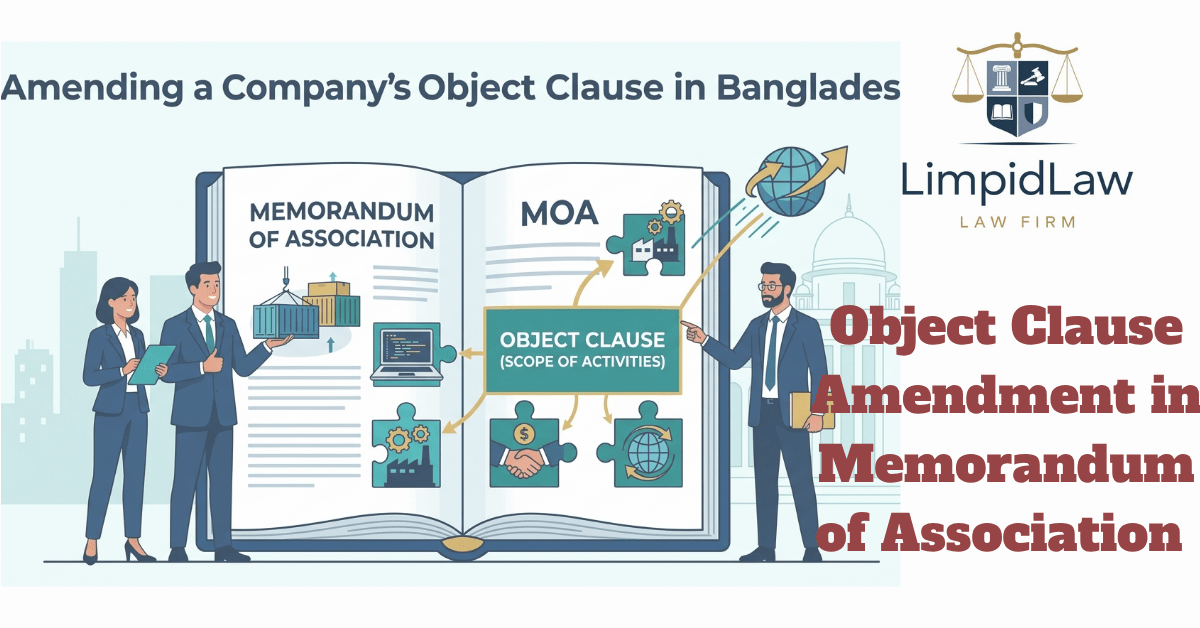
Bangladesh has emerged as one of South Asia’s fastest-growing economies, attracting entrepreneurs, startups, and foreign investors seeking new business opportunities. If you are planning to establish a business in Bangladesh, understanding the company registration process in Bangladesh is essential for ensuring legal compliance and a smooth business launch.
This guide explains the legal requirements, registration procedure, costs, timelines, and post-incorporation obligations for setting up a company in Bangladesh— in plain, practical terms.
Why Register a Company in Bangladesh?
A registered company enjoys a separate legal identity, limited liability protection, greater credibility, and easier access to banking, investment, and commercial opportunities. Compared to other business structures, a private limited company remains the preferred choice for both local and foreign investors due to its flexibility, scalability, and legal protection.
Types of Business Entities in Bangladesh
Before starting a business, investors should determine the most suitable legal structure. The common forms of business entities include:
- Private Limited Company
- Public Limited Company
- Branch Office
- Liaison Office (Representative Office)
- Sole Proprietorship
Among these options, a private limited company is generally the most practical structure for conducting commercial activities and generating revenue.
Why Choose a Private Limited Company?
For most entrepreneurs and foreign investors, a private limited company is the preferred choice — and for good reason. The formation of a private limited company offers several advantages:
- Separate legal entity from its owners
- Limited liability protection for shareholders
- Ability to own assets and enter contracts
- Greater business credibility
- Easier fundraising and ownership transfer
- Eligibility for 100% foreign ownership in most sectors
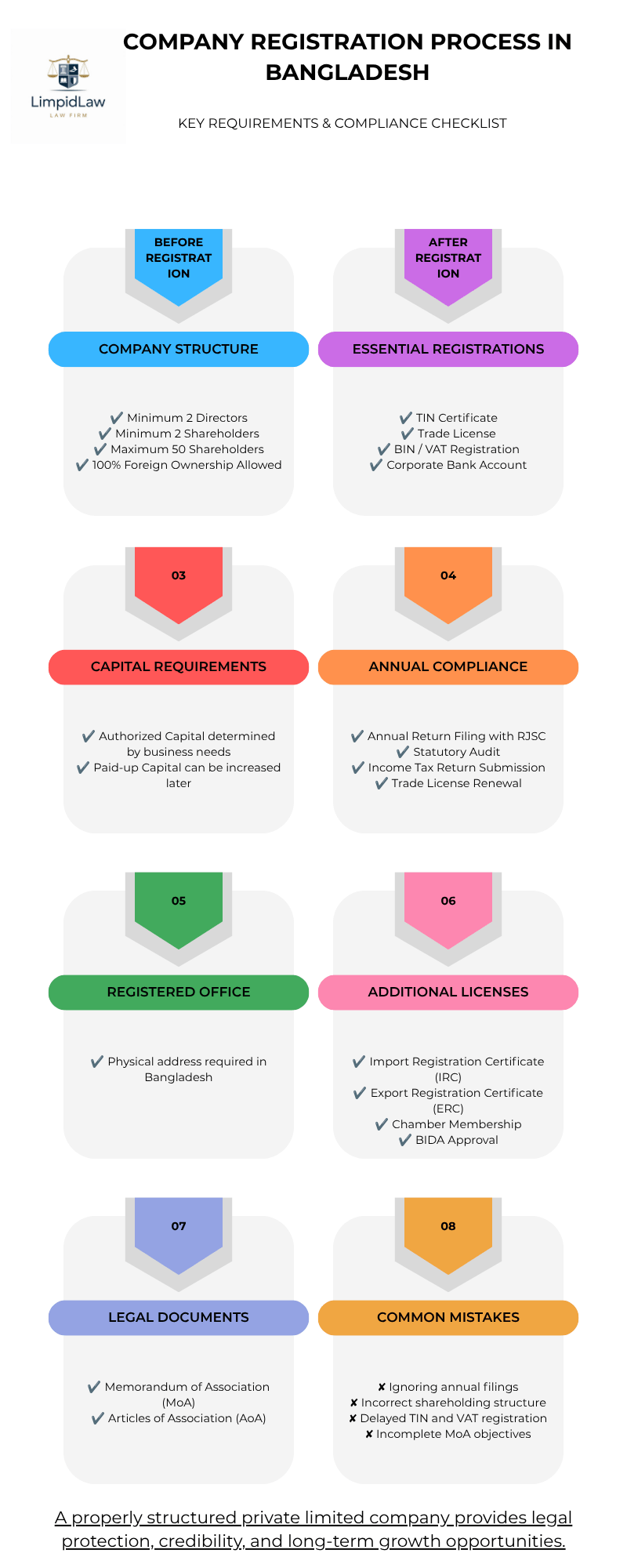
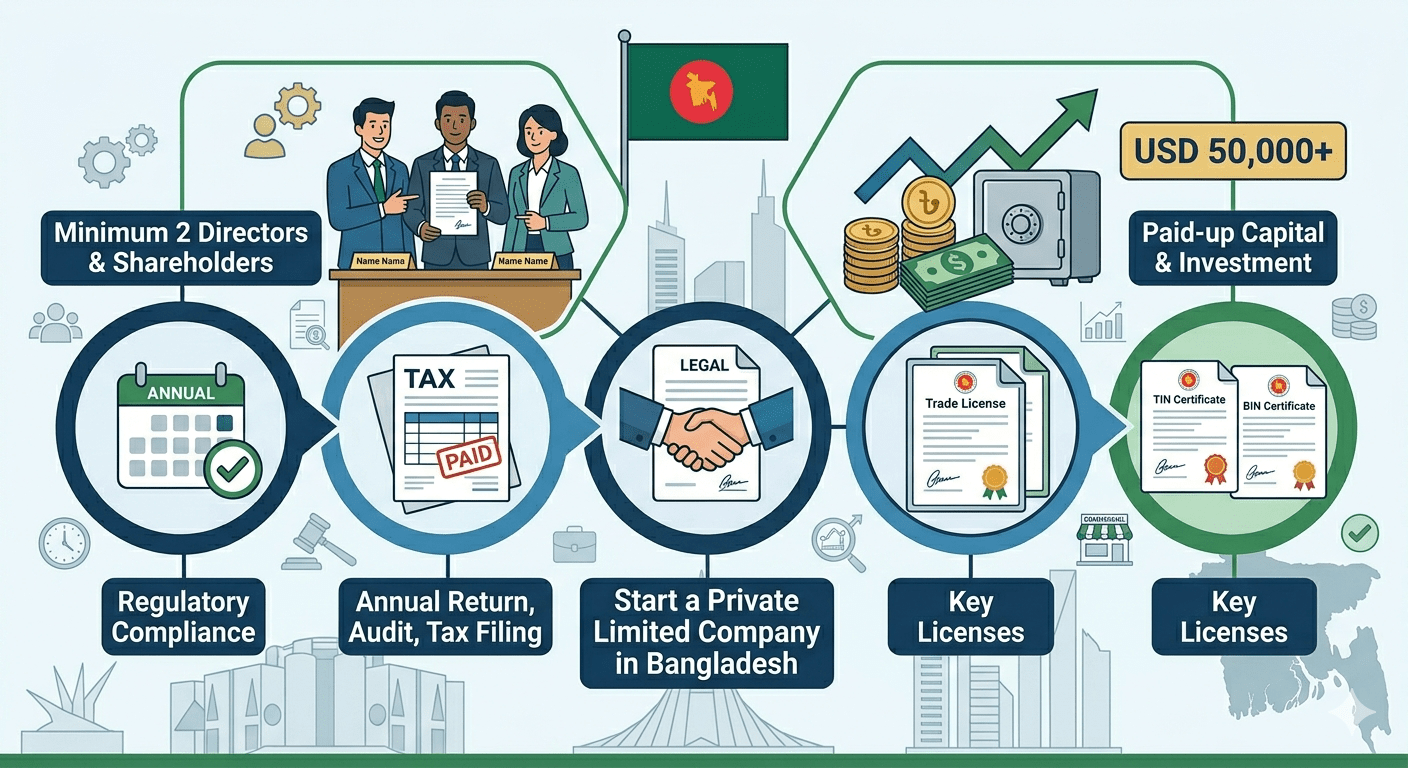
Understanding the full company formation process in Bangladesh begins with knowing what a private limited company requires before you file a single document.Under the Companies Act, 1994, a private limited company must have at least two shareholders and two directors and may have up to fifty shareholders.
Key Requirements before Registration
Company Name
A proposed company name must be approved by the Registrar of Joint Stock Companies and Firms (RJSC) before incorporation.Names that closely resemble existing registered entities or contain restricted terms will not be approved.
Directors
- Minimum: 2 directors
- Directors may be Bangladeshi or foreign nationals
- Must be at least 18 years old
- Must not be declared bankrupt or disqualified by law
- Each director must hold qualification shares as specified in the Articles of Association.
Shareholders
- Minimum: 2 shareholders and Maximum: 50 shareholders (A director and a shareholder can be the same individual.)
- Individuals or corporate entities may act as shareholders
- 100% foreign ownership is permitted in most sectors subject to applicable regulations.
Registered Office Address
Every company must maintain a physical registered office address in Bangladesh.. A P.O. Box does not qualify.
Authorized Capital
This is the maximum share capital the company is authorized to issue, and must be stated in the Memorandum of Association (MoA) and Articles of Association (AoA). There is no statutory minimum for local companies. However, for a foreign-owned company seeking full operational flexibility — including bringing in expatriate staff — a minimum investment of USD 50,000 is practically required.
Paid-Up Capital
The paid-up capital is the amount invested by shareholders in exchange for shares. This amount may be increased after incorporation if necessary.The statutory minimum paid-up capital is BDT 1 for a locally owned company and USD 50,000 for a foreign-owned company.
Constitutional Documents
Every company must prepare:
- Memorandum of Association (MoA)
- Articles of Association (AoA)
These documents define the company’s objectives, governance structure, and internal rules.
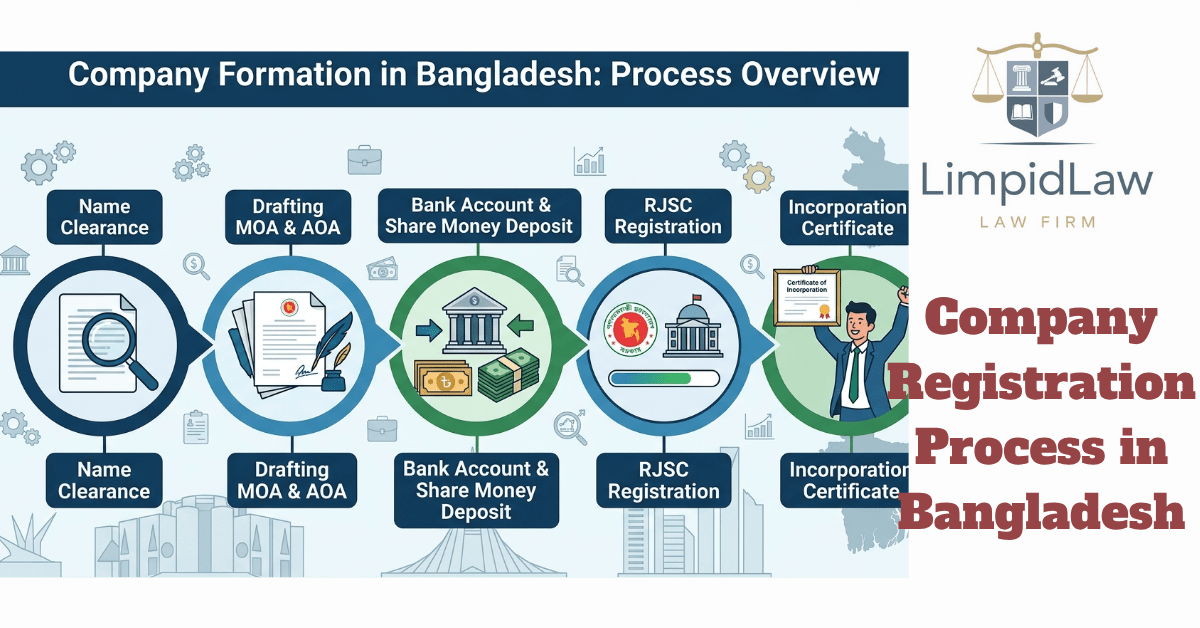
How to Open a Company in Bangladesh: Step-by-Step Process
Step 1: Obtain Name Clearance
The first stage is applying to RJSC for name clearancethrough the RJSC e-Service System.
Typical timeline: 1–2 working days.
Step 2: Draft the Memorandum of Association
The Memorandum of Association outlines:
- Company objectives
- Scope of business activities
- Share capital structure
- Liability provisions
A properly drafted MoA is critical because it defines the company’s legal capacity to conduct business.
Step 3: Draft the Articles of Association
The Articles of Association establish the internal governance framework of the company, including:
- Powers of directors
- Share transfer procedures
- Board meetings
- Appointment of officers
- Decision-making processes
Step 4: Open a Temporary Bank Account (Foreign Investors)
Foreign shareholders must open a temporary bank account under the proposed company name before incorporation with a scheduled bank in Bangladesh.
Documents generally include:
- Name clearance certificate
- Draft MoA and AoA
- Passport copies
- Photographs of directors
- Board resolution
Step 5: Capital Remittance and Encashment Certificate
Foreign shareholders must remit share capital through official banking channels. After receiving the funds, the bank issues an encashment certificate, which is mandatorily required for RJSC filing.
Step 6: Submit Incorporation Documents to RJSC
The following documents are needed to be submitted electronically to RJSC online portal:
- Memorandum of Association
- Articles of Association
- Encashment Certificate (where applicable)
- Director and shareholder information
- Registered office details
- Capital information
- and other prescribed forms
The RJSC then generates a payment invoice for registration fees and stamp duty, which must be paid through a recognized scheduled bank. Government fees are calculated based on authorized capital. Upon review and payment of government fees, RJSC processes the application.
Step 7: Receive Certificate of Incorporation
Upon verifying all documents and cross-checking the encashment certificate with the issuing bank, the RJSC issues the Certificate of Incorporation. This certificate carries the company’s registration number, its legal name, and the date of incorporation — and under Section 29 of the Companies Act, 1994, it serves as conclusive evidence of the company’s legal existence.
The RJSC also issues Form XII listing the directors, and certified copies of the MoA and AoA.
The overall process, when documents are in order, typically takes between 20 to 30 working days, though delays may occur with high application volumes or documentation errors.
Documents Required for Company Registration
Generally, the following information and documents are required:
- Passport or NID of directors and shareholders
- TIN (for Bangladeshi nationals)
- Passport-size photographs
- Registered office address
- Shareholding structure
- Details of directors and managing director
- Authorized capital amount
- Paid-up capital amount
- Bank signatory details
Government Fees and Registration Cost
Government fees primarily depend on the amount of authorized share capital.
There may be required additional expenses for Professional fees, drafting costs, notarization, and foreign document legalization (for foreign investors).
Post-Incorporation Registrations
After incorporation, several additional registrations are usually required.
Tax Identification Number (TIN)
A company must obtain a TIN from the National Board of Revenue (NBR).
Trade License
The company must obtain a trade license from the relevant City Corporation, Municipality, or local authority.
Typical processing time: 3–4 working days.
VAT Registration (BIN)
Businesses subject to VAT requirements must obtain a Business Identification Number (BIN).
Typical processing time: 5–7 working days.
Corporate Bank Account
After incorporation, a permanent corporate bank account can be opened using:
- Certificate of Incorporation
- MoA and AoA
- TIN Certificate
- Board Resolution
Additional Licenses Depending on Business Activities
Certain businesses may require sector-specific approvals, including:
- Import Registration Certificate (IRC)
- Export Registration Certificate (ERC)
- Bangladesh Investment Development Authority (BIDA) Registration
- Industrial Licenses
- Environmental Clearances
- Industry-specific regulatory approvals
Investors engaged in import-export activities typically require Chamber of Commerce membership and registrations with the Office of the Chief Controller of Imports and Exports.
Foreign Investment Rules in Bangladesh
Bangladesh permits 100% foreign ownership across most sectors. Foreign investors must register with BIDA, remit capital through proper banking channels, and obtain tax clearance before repatriating dividends or profits. Certain industries remain restricted or regulated, including defense-related activities, nuclear energy, and some tobacco-related operations.
For foreign-owned companies, the formation of a private limited company also requires compliance with Bangladesh Bank’s foreign exchange regulations, making legal guidance particularly valuable at the outset.
Regulatory Compliance After Registration
Registering a company is only the beginning. Ongoing compliance is equally important.
Annual Return Filing
Companies must file annual returns with RJSC. The first filing is generally required within 18 months of incorporation and subsequently every year.
Annual General Meeting (AGM)
Private limited companies must hold Annual General Meetings in accordance with the Companies Act, 1994.
Statutory Audit
All registered companies are generally required to maintain audited financial statements.
Tax Return Filing
Annual income tax returns must be filed with NBR.
Trade License Renewal
Trade licenses require periodic renewal according to local authority requirements.
Common Mistakes to Avoid
Many entrepreneurs face unnecessary delays due to avoidable mistakes such as:
- Not checking name availability before committing to branding and marketing
- Preparing a Memorandum of Association that does not accurately capture the company’s business objectives
- Delaying TIN and VAT registration after incorporation
- Creating an unsuitable shareholding structure that later creates complications
- Ignoring annual RJSC filing obligations, which can result in penalties and compliance issues
- Failing to maintain proper corporate records
Proper legal guidance at the beginning can help avoid costly corrections later.
Frequently Asked Questions (FAQs)
1. What is the company registration process in Bangladesh? or What are the steps to register a company in Bangladesh?
The main steps are: (1) Obtain name clearance from the RJSC; (2) Draft the MoA and AoA; (3) Open a provisional bank account and remit capital (for foreign investors); (4) Submit incorporation documents and pay fees through the RJSC online portal; (5) Receive the Certificate of Incorporation; (6) Complete post-incorporation registrations (TIN, Trade License, BIN).
2. How long does company registration take in Bangladesh?
For local investors, registration may take approximately 1–3 weeks. Foreign-owned companies may require additional time due to banking and investment compliance procedures.
3. How much does it cost to register a company in Bangladesh?
The cost depends primarily on authorized capital, government fees, VAT, and professional service charges.
4. Can a foreigner own 100% of a company in Bangladesh?
Yes. Bangladesh permits 100% foreign ownership in most sectors, subject to applicable regulatory requirements. The process requires remitting paid-up capital from abroad, obtaining an Encashment Certificate, and in some cases registering with BIDA. Directors can be either local or foreign nationals.
5. What are the minimum requirements for a private limited company?
A private limited company generally requires at least two directors, two shareholders, a registered office address, and constitutional documents.
6. What documents are required for company incorporation?
Key documents include identification documents, photographs, company address details, capital structure information, and constitutional documents.
7. What is the difference between authorized capital and paid-up capital?
Authorized capital is the maximum amount of share capital a company is legally permitted to issue, as stated in its MoA. Paid-up capital is the actual amount shareholders have paid for shares issued to them. The authorized capital sets the ceiling; paid-up capital is the amount actually received. Paid-up capital can be increased at any time after incorporation.
8. Is VAT registration mandatory for every company?
Not necessarily. VAT registration requirements depend on the nature and turnover of the business.
10. Do companies need to file annual returns with RJSC?
Yes. Annual returns and other statutory filings must be submitted to RJSC in accordance with the Companies Act, 1994.
11. Can a foreign company open a branch office in Bangladesh?
Yes. Foreign companies may establish branch offices or liaison offices subject to regulatory approvals.
12. Do I need BIDA approval for foreign investment?
Many foreign investment projects require registration or facilitation through the Bangladesh Investment Development Authority (BIDA), depending on the nature of the investment. (bida.portal.gov.bd)
13. Is it necessary to hire a lawyer to register a company in Bangladesh?
While it is not a legal requirement, engaging a qualified lawyer or legal firm is strongly advisable — particularly for foreign investors. The registration process involves precise document drafting, regulatory compliance across multiple bodies, and banking procedures that, if handled incorrectly, can cause significant delays and additional costs.
14. What documents are required for company registration in Bangladesh?
Core documents include: a name clearance certificate, Memorandum of Association, Articles of Association, director identification details (NID or passport, TIN for Bangladeshi nationals), director photographs, a Form IX (Consent of Director), Form XII (Particulars of Directors), and — for foreign investors — an Encashment Certificate from the bank.
15. What is an Encashment Certificate and when is it required?
An Encashment Certificate is issued by a scheduled bank in Bangladesh confirming that foreign funds have been received and converted into local currency. It is required only for companies with foreign shareholders, who must remit the paid-up capital from outside Bangladesh before the RJSC will process the incorporation.
16. Can a company have both Bangladeshi and foreign shareholders?
Yes. Joint venture companies — with both local and foreign shareholding — are a common and fully permissible structure. Shares can be distributed in any proportion, and new shares can be issued or existing shares transferred to any person at any time after incorporation.
17. What happens after company registration in Bangladesh?
After receiving the Certificate of Incorporation, the company must obtain a Tax Identification Number (TIN) from the NBR, a Trade License from the City Corporation, and a Business Identification Number (BIN) for VAT purposes. Ongoing obligations include annual RJSC filings, statutory audits, annual tax returns, and trade license renewals.
Conclusion
Understanding the company formation process in Bangladesh is crucial for establishing a legally compliant and sustainable business. While the incorporation procedure is relatively straightforward, careful planning is required regarding ownership structure, regulatory compliance, taxation, licensing, and ongoing corporate obligations. Whether you are a local entrepreneur or an overseas investor, obtaining professional legal assistance can significantly reduce delays and ensure that your business is structured correctly from the outset.
The content of this blog is for knowledge or information sharing purpose only and may not be relied on as legal advice. In terms of getting any legal help we always strongly advise to contact a professional lawyer. For professional legal help you can call or contact here.
Written By:
Sheikh Saiful Islam Rajib
Advocate, Supreme Court of Bangladesh