If you’re looking to get a clear, friendly overview of how Muslim marriage and divorce law in Bangladesh works — especially with its practical implications — you’re in the right place. We’ll explore the key rules, compare the roles of men and women, and explain how things like registration, divorce procedures, and legal rights play out in everyday life.
When it comes to muslim marriage and divorce law in bd, several major legal frameworks apply:
- The Muslim Family Laws Ordinance, 1961 (MFLO) sets out how divorce by the husband (talaq) must proceed.
- The Dissolution of Muslim Marriages Act, 1939 gives women married under Muslim law grounds to seek dissolution of marriage by court.
- The Muslim Marriages and Divorces (Registration) Act, 1974 along with its rules requires marriage and divorce registration for validity and legal recognition.
- Family Courts Ordinance, 1985 – Establishes the court system for handling family disputes
These frameworks combined make up what we might call the muslim marriage and divorce registration act environment in Bangladesh.
Key points of the Muslim Marriage and Divorce Law in Bangladesh are:
Marriage Basics: Entering the Union
When two people marry under Muslim law in Bangladesh:
Both parties must be Muslim
Both must be of sound mind and adult
Free and voluntary consent from both sides
At least two witnesses (note: two female witnesses equal one male witness in this context)
The marriage, or Nikahnama, must be registered under the Muslim Marriages and Divorces (Registration) Act, 1974 to ensure legal recognition.
Once married, the relationship is seen as a contract with rights and obligations on both sides.
The Muslim Marriages and Divorces (Registration) Act, 1974 requires all Muslim marriages to be registered by a government-appointed local Nikah registrar (typically called Kazi), within maximum 30 days of the solemnization. Failure to register is a punishable under these Act.
Polygamy is permitted under Islamic law but restricted to a maximum of four wives at a time, with the condition that the husband must treat all wives equally.
In Bangladesh, the legal framework governing marriage sets the basic criteria: both parties must be adult and sound-minded; the minimum age at 21 for men and 18 for women. This standard is established by the Child Marriage Restraint Act of 2017, which updated the former legislation from 1929. Under this law, any individual below these specified ages is legally considered a minor for the purpose of marriage. The Act explicitly prohibits arranging, permitting, or officiating a marriage where either party is a child. However, the legislation includes a notable and often debated clause. Section 19 introduces a “special provision” that permits marriages below the minimum age under what it defines as “exceptional circumstances” or if such a union is deemed to serve the minor’s “best interest,” provided a court grants official approval. This particular exception has been met with considerable concern from human rights advocates. Critics contend that it creates a significant loophole, potentially weakening the law’s overall effectiveness and hampering national efforts to eradicate child marriage.
The mahr (a mandatory gift from the groom to the bride) must be agreed upon, often money or jewelry, and is considered a deferred debt.
Thus, when discussing muslim marriage in Bangladesh, it is not just a cultural or religious ritual — there’s a formal legal layer too.
Divorce: When Things Don’t Work Out
Let’s walk through the divorce side of things — or more specifically, the Bangladesh divorce law as it relates to Muslims.
Now we get to the part nobody wants to think about on their wedding day. Divorce is never easy, but understanding the process can make a difficult situation slightly less overwhelming.
Why Does Islam Permit Divorce?
The Prophet Muhammad once said, “Of all the lawful things, divorce is the most hated by Allah”. Islam doesn’t encourage divorce, but recognizes that sometimes it’s inevitable. When spouses can’t live together with mutual affection and love, forcing them to stay together creates more harm than good.
Divorce by Husband: Talaq
Under Section 7 of MFLO 1961, when a husband pronounces unilateral divorce (talaq):
He must give written notice to the Chairman of the Union Parishad (or relevant authority) and a copy to his wife.
An arbitration council must be set up within 30 days to attempt reconciliation.
There is an ‘iddat’ period (typically 90 days), or if the wife is pregnant, until the pregnancy ends, after which the divorce takes effect.
Important Warning: Breaching this procedure can result in simple imprisonment for up to one year or a fine up to 10,000 taka, or both.
Divorce by Wife or Mutual Divorce
For women, or in mutual divorce:
Under section 2 of the Dissolution of Muslim Marriages Act 1939, a wife can seek dissolution on specific grounds (e.g., husband missing for 4 years, failure to provide maintenance for 2 years, impotency, mental illness, etc.)
There are other forms of Divorce:
By mutual consent (mubarat):
Thinking of a mutual divorce? In Islamic law, this is often known as Mubarat—a process where both husband and wife jointly agree to end their marriage.
The key advantage of Mubarat is its simplicity compared to other divorce methods. To begin, the couple submits a joint petition to the Family Court, where they will explain their mutual decision.
However, “mutual” doesn’t mean it’s instant. The law has important steps in place to ensure the decision is considered. The court will typically encourage a reconciliation effort to see if the marriage can be saved. If that doesn’t work, there is a mandatory waiting period, known as the Iddat, which lasts for at least three months. Only after this period does the divorce become officially final.
Wife-initiated divorce by khula:
In Bangladesh, a Muslim wife has the right to initiate a divorce through a process known as Khula. Typically, when a wife pursues Khula, she voluntarily agrees to give up certain financial rights, such as her mahr (dower), in exchange for the divorce.
The process can unfold in two primary ways, depending on the husband’s cooperation.
a) Khula by Mutual Consent-
This is the most straightforward path. Here’s how it works:
The wife makes a formal request for divorce to her husband. As part of the agreement, she offers to forfeit her financial claims. Once the husband gives his consent, the divorce is finalized through the local Kazi/ Nikah Registrar or a court to make it legally official.
b) Khula Through the Court-
What happens if the husband refuses to consent or the situation is untenable? The wife is not without options. She can file a petition for Khula in the family court.
This legal route is designed for challenging circumstances, such as:
Cruelty or abuse
Desertion or abandonment
A husband’s failure to provide financial maintenance
In such cases, the court intervenes to evaluate the situation and can grant the divorce, ensuring the wife’s right to seek a safe and dignified end to the marriage.
Talaq-i-tafweez (delegated power):
In Bangladesh, talaq-i-tafweez is a provision that allows a Muslim wife to end the marriage if her husband has given her the delegated right to do so.
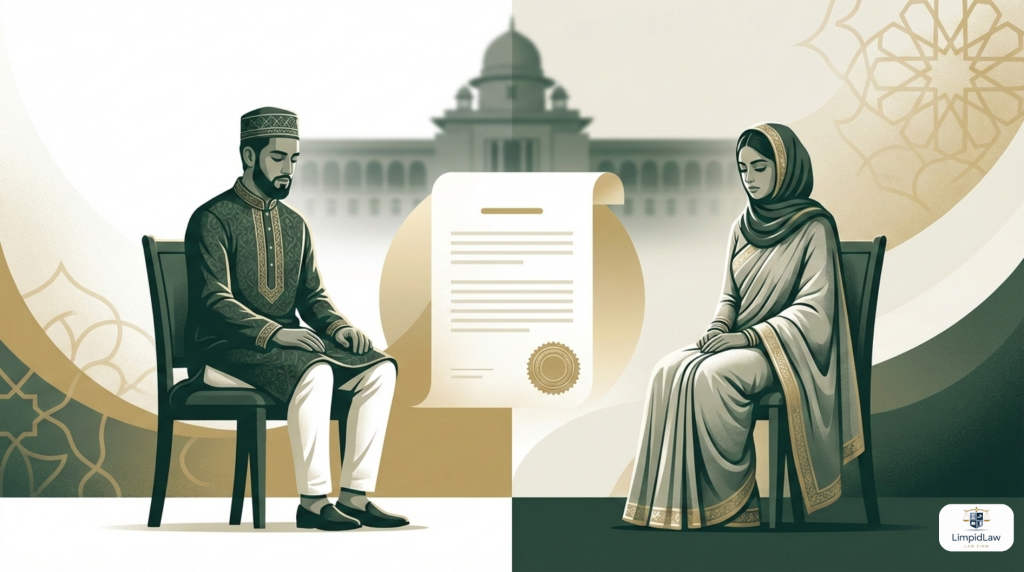
Column 18 specifically asks whether the husband has delegated the right of divorce to his wife and, if so, under what conditions ? This makes the process clear and legally recognized from the very beginning of the marriage. The marriage registrar (Kazi) generally ensures that Bride/ wife get this delegated right of divorce.
- Divorce requires procedural steps such as pronouncement, notice to the chairman of the union parishad, and an arbitration council attempt at reconciliation within 90 days.
- Divorce becomes effective after an ‘iddat’ period of three months, which may be extended if the wife is pregnant.
- Maintenance after divorce is guaranteed for 90 days or until childbirth if pregnant at divorce, with possible extensions for child support and spousal maintenance.
- Women have specific rights such as choosing their husband, receiving mahr, and seeking divorce under certain conditions via delegation (Talaq-i-Tafwid) or legal decree under the Dissolution of Muslim Marriages Act, 1939.
- Grounds for a wife to seek divorce include absence of husband, failure of maintenance, imprisonment, cruelty, impotency, and forced marriage before age 18, among others.
These laws aim to balance Islamic principles with legal formalities for marriage and divorce, safeguarding rights of spouses, especially women, in Bangladesh
Why Registration and Procedure Matter
Let’s talk through why the formalities of “registration”, “notice”, and “arbitration council” matter:
- Without registration of marriage or divorce, a spouse may face issues with inheritance, remarriage, child custody, maintenance claims, or recognition of the separation. For example, the law states a divorce may be “registered” under the registration act.
- The notice and iddat period ensure that the spouse is aware and there is an opportunity for conciliation — aligning with Islamic precept that divorce is a last resort.
- Properly following the process prevents later disputes about whether the divorce was valid under law (or religiously binding) — a practical as well as ethical concern.
Finding a Bangladeshi Divorce Lawyer Near Me
Sometimes you need professional help. Whether you’re in Dhaka or anywhere else in Bangladesh, here’s what to look for:
When to Hire a Lawyer:
- Complex property disputes
- Child custody issues
- Contested divorce where your spouse refuses
- When seeking judicial divorce through court
- If you’re unsure about your rights
For mutual divorces, lawyers aren’t strictly mandatory, but legal advice never hurts. For court proceedings, having experienced representation becomes essential.
Key Insights You Should Know
Here are some punchy take-aways:
- Marriage is assumed to be the default: The law treats marriage as the norm and divorce as an exception.
- Not just religious but legal process: The interplay between religious personal law and state statutes means you can’t simply rely on a private “Nikah” without following formal law.
- Registration is increasingly important: Both for marriage and divorce, registration acts are proving essential to protect rights.
- Women’s rights in divorce are more limited—but evolving: The divorce process for women exists, but it still places more burden on the wife. Advocates continue to push for reform.
- Polygamy has a legal ceiling: While Islamic law may allow up to four wives, Bangladeshi law restricts a man from contracting another marriage without permission from an Arbitrary Council.
- Mutual resolution is smoother: When both spouses agree (mubarat, khula) things tend to proceed faster with fewer disputes.
Moving Forward After Divorce
After divorce becomes final, both parties can remarry. However, women must complete the Iddah period (three menstrual cycles or three months) before remarrying, while men can remarry after receiving the divorce certificate.
The divorce certificate becomes your official proof of marital status dissolution. You’ll need it for:
- Remarriage
- Property settlements
- Overseas documentation
- Legal proceedings
FAQs: What People Commonly Ask
Here are frequently asked questions (with concise answers) around muslim marriage and divorce law in Bangladesh:
Q1. What is the process under Bangladesh divorce law in Bangla?
A: In Bangladesh, when a Muslim husband pronounces talaq, he must give a written notice to the Union Parishad chairman and to his wife. An arbitration council must attempt reconciliation. If reconciliation fails, then after the iddat (usually 90 days) the divorce becomes effective.
Q2. Can a Muslim wife divorce her husband in Bangladesh?
A: Yes — under the Dissolution of Muslim Marriages Act, a wife can petition for dissolution. Women have several options: Talaq-e-Tafweez if the right was delegated at marriage, Khula with husband’s consent or court assistance, Mubarat (mutual separation), or judicial divorce through Family Court on specified grounds like non-maintenance, cruelty, desertion, missing husband for four years, impotency, insanity, etc.).
Q3. What happens if a divorce is not registered under the Muslim Marriages and Divorces (Registration) Act?
A: Without registration, the legal status of the divorce may be unclear, affecting future rights to remarriage, maintenance, inheritance, etc. It can complicate enforcement of the separation.
Q4. What is “muslim marriage separation” in practical terms?
A: It refers to when spouses decide to live apart and formally end the marital relationship under the relevant laws — either through unilateral talaq, mutual agreement (mubarat, khula), or judicial dissolution.
Q: Is divorce without notice valid in Bangladesh?
A: According to recent Supreme Court decisions, divorce registration under section 6 of the Act finally dissolves the matrimonial tie, and non-service of notice under section 7 cannot render divorce ineffective if the husband’s conduct shows clear intention not to revoke it. However, skipping notice can lead to penalties including imprisonment up to one year or fines up to 10,000 taka. It’s always better to follow proper procedure.
Q: How long does the divorce process take?
A: For simple uncontested divorce, it takes 90 days from notice. If court involvement is required for contested matters, expect 6 months to 1 year depending on case complexity and court schedules.
Q: What happens to the dower (mahr) after divorce?
A: The divorced wife generally retains her dower, both the prompt portion and any deferred amount specified in the marriage contract. However, in Khula divorces, wives typically waive their dower rights as part of the settlement.
Q: Do I need a lawyer for divorce in Bangladesh?
A: For mutual divorce, a lawyer is not mandatory, but for court divorces, legal representation is recommended. Given the complexity of family law and potential for disputes, consulting a lawyer always helps to protect your interests even in seemingly straightforward cases so yes hiring a lawyer for divorce in Bangladesh is very important .
Q: What is the Arbitration Council and what do they do?
A: When divorce notice is served, the local government authority e.g. Chairman constitutes an Arbitration Council within 30 days. Their primary purpose is attempting reconciliation between spouses during the 90-day waiting period. They cannot prevent the divorce but serve as mediators hoping to save the marriage.
Q: Can a husband marry again immediately after divorce?
A: Men can remarry after receiving the divorce certificate.
Q: Is maintenance provided after divorce?
A: Muslim personal law provides maintenance for only 90 days from the official notice date, or if the wife was pregnant at the time of divorce, until the child’s birth.
Q: Can divorce be finalized before 90 days?
A: Generally no. The 90-day period is legally mandated to allow for reconciliation. However, the talaq becomes effective after 90 days expires unless revoked earlier by the husband. The only exception is if the wife becomes pregnant, which may extend the timeframe.
Q: What if my spouse refuses to agree to divorce?
A: You have options. Men can initiate unilateral talaq following proper procedure. Women can seek judicial divorce through Family Court, which can grant dissolution even without husband’s consent if valid grounds exist. This is where having a competent lawyer becomes crucial.
Q: Does the Bangladesh government recognize religious divorce (talaq) without registration?
A: The Supreme Court has held that “Talaq in any form shall not be talaq in the eye of law unless provisions of section 7(1) of the Muslim Family Laws Ordinance 1961 are sternly complied with”. Registration makes your divorce legally recognized and documented.
Q: Is non-registration of a marriage a crime?
A: Yes, under the Muslim Marriage and Divorce Registration Act, 1974, failure to register a marriage is a punishable offense with simple imprisonment, a fine, or both. While the marriage itself remains religiously valid, non-registration creates significant hurdles in establishing legal rights, particularly in case of divorce or inheritance.
Q. Can a wife ask for divorce if the husband has committed polygamy?
Yes. Under the Dissolution of Muslim Marriages Act, 1939, a wife has the right to obtain a judicial divorce on the grounds that her husband has taken a second wife. It is also mandatory that the husband take written permission from local Arbitration Council (as required by MFLO, 1961).
Final Thoughts
Navigating Muslim marriage and divorce law in Bangladesh is about balancing religious principle, statutory formalities, and human realities. The main keyword, Muslim marriage and divorce law in Bangladesh, captures the full spectrum — from how marriages are formed, to how they may end, and what the legal safeguards are for all parties involved.
You’ll find that the system is structured to protect marriage as the norm, while providing avenues for divorce when staying together becomes untenable. The formal steps—notice, arbitration, iddat, registration—are more than paperwork: they reflect values of fairness, transparency, and due process.
Whether you’re considering marriage or facing divorce, knowledge is your greatest asset. While this guide provides a comprehensive overview, every situation has unique aspects. Don’t hesitate to consult with legal professionals who can address your specific circumstances.